The short answer
IVF clinic marketing in India works when a clinic shows up in local search and Google Maps, answers patients' questions honestly on its own website, replies to enquiries within minutes, and keeps every claim inside the ART Act, NMC guidelines and each ad platform's health policy. Paid ads help only after those basics are in place. Success-rate claims, testimonials and before-and-after content carry the biggest legal risk.
This guide is general information, not legal advice. Rules in this area are changing, so have your lawyer read the original texts before you publish anything.
Key takeaways
- The World Health Organization says about 1 in 6 people of reproductive age worldwide experience infertility in their lifetime, so a clinic's job is to be found and trusted, not to create demand.
- The ART (Regulation) Act, 2021 bans advertising sex-selective ART in any medium including the internet, with a prison term of five to ten years or a fine of ₹10 lakh to ₹25 lakh, so keyword lists and landing pages need a hard filter for it.
- The NMC's ethical advertising guidelines of 6 October 2026, as reported, bar doctors from advertising personal success rates or patient numbers, and from using testimonials and before-and-after photographs, even with patient consent.
- Meta allows IVF ads only to adults aged 18 and above, and Google requires advertisers in healthcare categories to be certified, so the first week of any campaign is account and policy work, not creative.
- The best measure of IVF marketing is cost per started treatment, not cost per lead, because a lead who never books a consultation costs money and produces nothing.
Why is IVF marketing different from other clinic marketing?
IVF marketing is different because the decision is emotional, expensive, slow and heavily regulated, so trust built on facts matters more than loud offers. Couples research privately and compare several clinics before they call.
A discount offer risks breaching NMC rules, which as reported prohibit discounts, contests and referral benefits that encourage unnecessary consultations or treatment. A happy-patient reel is usually off the table too, because the same guidelines prohibit success stories and testimonials.
DataReportal's Digital 2026 report for India counts 1.03 billion internet users, 70% of the population, with YouTube reaching 500 million people, Instagram 481 million and Facebook 403 million in ad-audience terms (data as of late 2025). The question is not whether couples are online. It is what they find when they look for you.
The need is real too. The WHO's infertility fact sheet of 28 November 2025 says about one in six people of reproductive age worldwide will experience infertility in their lifetime, and that fertility care is often unaffordable and unavailable.
What rules apply to IVF advertising in India?
Three layers apply at once: the ART (Regulation) Act, 2021, NMC advertising guidelines for doctors and hospitals, and each ad platform's health policy. When two rules differ, follow the stricter one.
The ART Act
Every ART clinic and bank must be registered with the National Registry, and, as SCC Online's summary of the Act notes, registration must be renewed every five years.
On advertising, Section 32 is explicit. A clinic, bank or agent "shall not issue, publish, distribute, communicate or cause to be issued" any advertisement "in any manner including internet" about sex-selective ART. The penalty is imprisonment of five to ten years, or a fine of ₹10 lakh to ₹25 lakh, or both. "Agent" can include your marketing agency.
A 2024 paper in the National Medical Journal of India by Mishra and Thakral adds that the Act "lacks regulation on the costs of services", so publishing clear prices is your choice, and a trust opportunity.
The rules are still moving: in July 2026 the National Commission for Women set up a panel to review how the ART Act and the 2026 Amendment Rules are being implemented, reported by MedBound Times. Check for new notifications before every campaign.
NMC guidelines
The Ethics and Medical Registration Board issued ethical advertising guidelines on 6 October 2026, effective immediately, as reported by Medical Dialogues. As reported, they prohibit:
- advertising personal success rates or patient numbers, and claims like "100% success";
- guarantees of cure and unverifiable superiority claims such as "best doctor";
- before-and-after photographs and success stories, except for scientific or educational use with anonymised consent;
- fake followers, likes and reviews, and manipulation of search rankings;
- unmarked AI-generated promotional content, and any AI creation or alteration of a patient's image, testimonial or outcome.
The South First's report adds that patient consent does not make a prohibited success claim acceptable, and that using an agency does not remove the doctor's responsibility. The notice itself is a scan we could not read, so read the original with your advisor and ask whether it applies to your clinic's structure.
Platform policies
Meta's health and wellness standard lists "In vitro fertilisation (IVF) or any other artificial insemination procedures" and fertility awareness among reproductive health ads that must target people aged 18 or older. It also bars promises of specific outcomes within a set time frame without qualifiers.
Google's healthcare and medicines policy says advertisers must be certified with Google, restricts fertility-related promotion in certain locations, and does not allow ads for pre-natal gender determination in India. The page does not say whether IVF clinic ads are permitted in India, so confirm with Google Ads support before you spend. Google's personalised advertising policy also lists "Health" and "Birth control" as sensitive interest categories where advertiser-curated audiences cannot be used.
What should an IVF clinic's website show first?
An IVF clinic's website should show the clinic's ART registration, each doctor's qualifications and medical registration, a plain explanation of the treatment steps, and a way to ask a question on WhatsApp or phone, all above the fold or one click away. We read the Bareilly pages of two clinic chains on 13 November 2026 to see what a couple finds. This lists what was visible on the page, not a judgement of the clinics:
| Check | Indira IVF Bareilly page | Nova IVF Bareilly page |
|---|---|---|
| ART registration number on the page | Not shown | Not shown |
| Doctor qualifications | Names and titles only | Degrees listed for two doctors |
| Street address and map | Yes | Not shown |
| On-page FAQ | No (links to a site-wide FAQ) | Yes, mostly generic |
| Success rate shown | "72%+", defined in a disclaimer as positive pregnancy blood tests across the chain in FY 2024-25 | None for Bareilly |
| Prices shown | Yes, with inclusions and exclusions | Yes, "starting" prices, no breakdown |
Sources: Indira IVF Bareilly and Nova IVF Bareilly, read on 13 November 2026. Pages change.
Both pages leave out a registration number and a Bareilly-specific outcome with a definition. A small clinic can beat a chain on these points, because the information is free to publish.
A page structure that works
- A "how IVF works here" page: steps, typical timeline, what needs a doctor's decision. No promises.
- A page for each doctor: qualifications, registration details, languages spoken.
- A cost page: what each treatment starts at, what is included, and what is billed separately.
- A "before you call" page: documents to carry, how to book, what the first visit covers.
- A visible compliance block: ART registration details and grievance contact.
How do you handle success-rate claims?
Do not advertise a success rate unless your lawyer has cleared the exact wording, because the NMC guidelines as reported bar doctors from advertising personal success rates, and a headline percentage is easy to read as a promise. If you publish any figure at all, say what was counted, who was counted and for which period.
The definition matters more than the number. Indira IVF's Bareilly page cites "72%+" but defines it in a disclaimer as positive pregnancy blood tests across its clinics in India for the year ending 31 March 2025. That is a chain-wide count of positive tests, not live births and not Bareilly outcomes. A couple reading "72%" will not assume that definition.
A safer approach is to teach, not to score. Explain that outcomes depend on age, diagnosis and the cycle, that a positive test is different from a live birth, and that the doctor will discuss likelihood in the consultation. If a number matters to a patient, give it in the consultation, in writing, with the doctor. Do not put it in an ad.
Which channels work for an IVF clinic?
Local search and Google Maps work first, a useful website second, and paid ads on Google and Meta third.
1. Google Business Profile and local search
A couple searching "IVF centre in Bareilly" sees a map, a few clinics and their ratings before opening any website. Your profile needs the exact clinic name, address, timings, services and a real photo of the entrance. See our Google Business Profile checklist for the full list.
Reviews matter, but the rules are strict. Google's review policy says merchants may not offer incentives, selectively solicit positive reviews, or ask staff to hit review quotas. The NMC guidelines as reported also ban fake reviews. Ask every couple for honest feedback, and never offer a discount for a review. Our guide to replying to Google reviews covers responding without revealing patient details.
2. Search-friendly pages
Write one page for each question a couple searches: IVF versus IUI, what a first consultation involves, how long a cycle takes, what treatment costs. Answer the question in the first two sentences, as this article does, so a search result or AI answer can quote it.
3. Google Ads
Search ads reach people already looking and carry the highest compliance burden. Three rules:
- Add negative keywords for sex selection and gender determination from day one, and review the search terms report every week.
- Send ads to a matching page with your registration details and a booking option.
- Count a conversion only when someone books a consultation.
4. Meta ads (Facebook and Instagram)
Meta ads suit local awareness and must target 18 and above. Keep ads factual: who you are, where, and what the consultation covers. Our clinic ads cost guide explains budgets and the 50-conversions-a-week rule.
5. WhatsApp as the front desk
A clinic needs one named person who replies, a short list of approved answers and a booking slot to offer. If you automate messages, read our WhatsApp Business API cost guide first.
How much does IVF marketing cost?
Plan for a cost per lead of about ₹150 to ₹800 on Meta, based on upGrowth's estimates for health and wellness advertisers (September 2026, method not published), then replace it with your own numbers after two to four weeks. There is no sourced benchmark for IVF specifically, or for Google Ads.
What matters is the cost per started treatment. Here is an illustration with invented numbers, only to show the arithmetic:
| Step | Illustration |
|---|---|
| Monthly ad spend | ₹40,000 |
| Cost per lead | ₹500 |
| Leads | 80 |
| Leads that book a consultation | 25% = 20 |
| Consultations that start treatment | 15% = 3 |
| Cost per started treatment | about ₹13,300 |
If only 5% of consultations start treatment, the same spend gives one couple and a cost of ₹40,000. That gap is decided mostly by reply speed, a clear cost page and the first consultation, not by the ad.
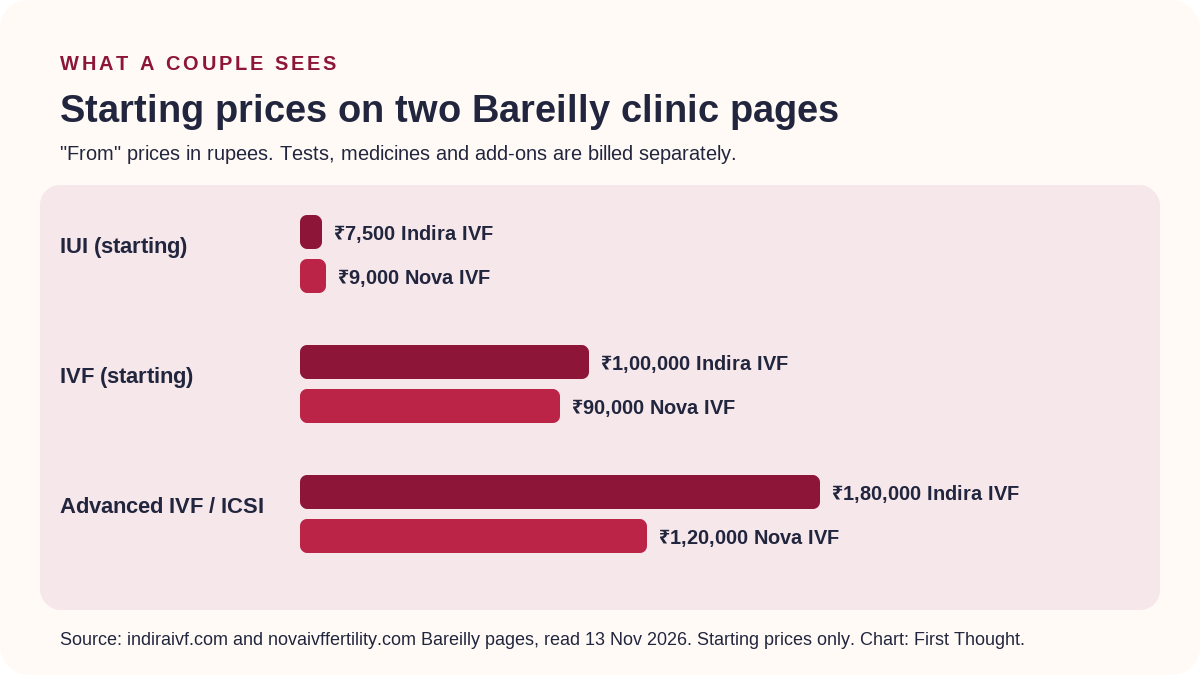
For context on what a couple is weighing, clinic-published starting prices on the two Bareilly pages above were: IUI from ₹7,500 (Indira IVF) and about ₹9,000 (Nova IVF); basic IVF from ₹1,00,000 (Indira IVF) and about ₹90,000 (Nova IVF); advanced IVF or ICSI from ₹1,80,000 (Indira IVF) and from about ₹1,20,000 (Nova IVF). Both say final cost depends on reports and the treatment plan, and Indira IVF excludes tests, medicines, freezing and donor charges.
We have no sourced range for agency fees, so ask for the fee, contract length and monthly reporting. Be careful with per-patient or per-lead commissions: the NMC guidelines as reported bar paying third parties for marketing and lead payments tied to patient referrals. Ask your advisor before you sign one.
What does a realistic plan look like for a clinic in a city like Bareilly?
A realistic plan fixes the Maps profile, website and reply process in month one, tests a small Google Search campaign for one service in month two, and only then adds Meta awareness ads.
Example (invented, not a real client): A two-doctor fertility clinic in Bareilly has a Google Business Profile with 40 reviews, a website with one contact form, and no WhatsApp number on the page. ThreeBestRated's Bareilly list ranks Indira IVF, Lotus IVF and Sunrise IVF, so couples will compare it with those names.
Month 1: foundations.
- Correct the Maps profile; publish doctor pages, a cost page and an FAQ.
- Add a WhatsApp button and one person who replies within 15 minutes.
Month 2: one search campaign.
- Run Google Search ads for one service in the clinic's city and nearby districts, with a monthly cap.
- Load the negative keywords; check search terms weekly.
- Log every enquiry: date, source, booked, attended, started treatment.
Month 3: review and decide.
- Compare cost per booked consultation and cost per started treatment.
- If the numbers are usable, add a small Meta awareness test for 18 and above.
How should a clinic handle patient data and privacy?
Treat every enquiry as sensitive health information. India's Digital Personal Data Protection Rules were notified on 14 November 2025, and the consent notice, deletion and breach obligations apply eighteen months after publication, which by our count is around May 2027.
SCC Online's summary says the notice must be clear, separate from other information and in simple language, must state the purpose, and must explain how a person can withdraw consent or complain. Data must be deleted once its purpose is fulfilled, with 48 hours' notice to the person.
Build this in now: a consent line on every enquiry form, no patient names or faces in ads or posts, and no WhatsApp messages to people who have not asked to be contacted.
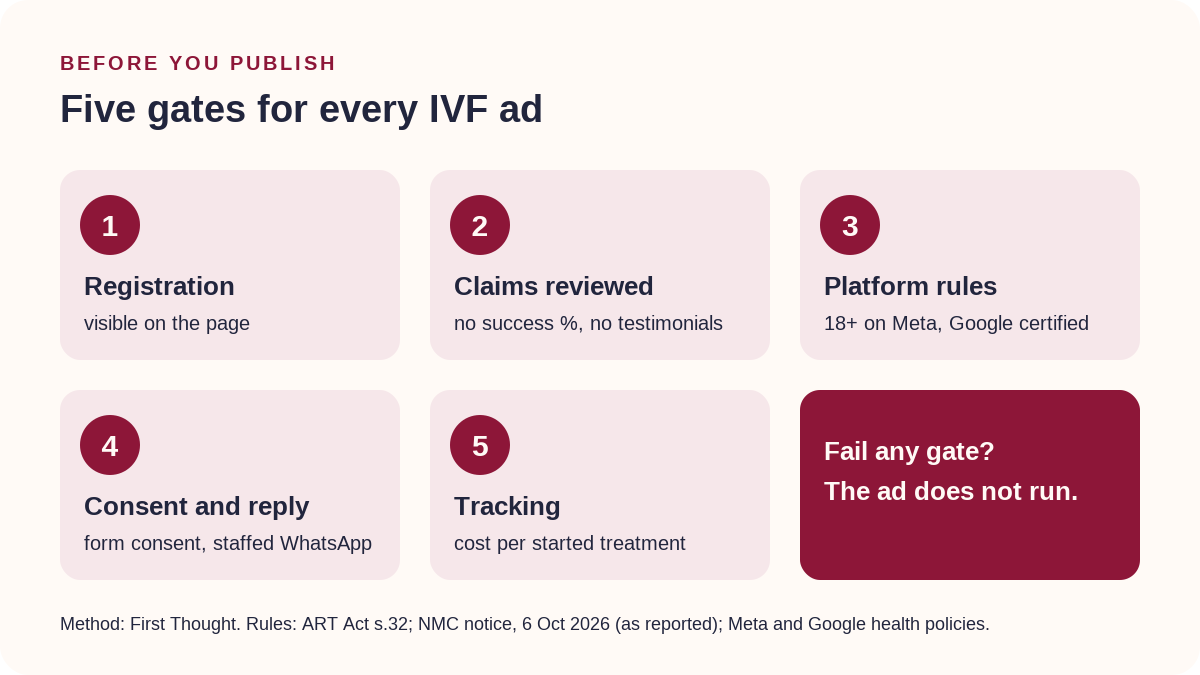
How do you check an IVF ad before it goes live?
Run every ad and landing page through five gates. If it fails any gate, it does not run.
- Registration visible. The page shows the ART registration and each doctor's registration.
- Claims reviewed. No success percentages, "best", "No.1" or "guaranteed", no testimonials, before-and-after images, patient faces or AI-made patient images.
- Platform rules checked. Meta age targeting is 18 and above, Google certification is in place, and negative keywords for sex selection are loaded.
- Consent and reply ready. The form has a consent line and the WhatsApp number is staffed.
- Tracking in place. Every enquiry is logged with its source, and booked and started-treatment counts are updated weekly.
Common mistakes to avoid
- Leading with a success rate. It invites a complaint, and it can breach the NMC guidelines as reported. Explain outcomes in the consultation instead.
- Using patient photos or stories. Consent does not fix this under the guidelines as reported.
- Letting an agency publish without your review. You stay responsible for content you authorised.
- Forgetting negative keywords. One stray gender-selection search term puts you near the one rule with a prison term.
- Claiming accreditation you do not hold. One guide, CalcGuru's 2026 note on starting an IVF centre, says there is no NABH accreditation programme for ART, so a general hospital accreditation should not be presented as an IVF-specific standard.
- Judging by leads. A cheap lead that never books is not cheap.
- Buying reviews or setting staff review quotas. Google bans both.
A practical next step
First Thought, a digital marketing and creative agency in Bareilly, Uttar Pradesh, works with hospitals, clinics and other local businesses on lead generation, creative and follow-up systems. For healthcare clients we keep every ad inside NMC, ASCI and platform rules: no testimonials, no outcome claims, no guarantees. We start with your current Maps profile, website and enquiry handling, and tell you what to fix before you spend. See our page on marketing for IVF and fertility clinics, our healthcare marketing page, our performance marketing service, or contact us for a free audit. We will tell you if your budget is too small for paid ads to teach you anything yet.
Frequently asked questions
How can an IVF clinic get more patients online in India?
Start with a complete Google Business Profile, a website with doctor details, a cost page and an FAQ, and a fast WhatsApp reply. Then test one Google Search campaign. Keep every claim inside the ART Act, NMC guidelines and platform policies, and judge results by cost per started treatment.
Is it legal to advertise IVF in India?
Advertising fertility services is not banned as a whole, but advertising sex-selective ART is, under Section 32 of the ART (Regulation) Act, 2021 (five to ten years in prison or a ₹10 lakh to ₹25 lakh fine). NMC guidelines and platform policies also limit what ads may say.
Can an IVF clinic show its success rate in ads?
The NMC guidelines of 6 October 2026, as reported, bar doctors from advertising personal success rates or patient numbers and prohibit claims like "100% success". A clinic that publishes a figure should say what was counted and for which period, after legal advice. Do not put one in an ad.
Can IVF clinics run Facebook and Instagram ads?
Yes, with limits. Meta allows IVF and fertility awareness ads only when they target people aged 18 or older, and bars promises of specific outcomes in a set time without qualifiers. The NMC rules on testimonials, photographs and guarantees still apply to the creative.
Can IVF clinics run Google Ads in India?
Possibly. Google requires advertisers in healthcare categories to be certified, restricts fertility promotion in certain locations and bans pre-natal gender determination ads in India. Its page does not say whether IVF clinic ads are allowed in India, so confirm with Google Ads support before you spend.
How much should an IVF clinic spend on digital marketing?
There is no sourced benchmark for IVF. One agency estimates Meta cost per lead for health and wellness at ₹150 to ₹800. Start with a capped budget for two to four weeks, then work out cost per booked consultation and per started treatment before you scale.
What does the DPDP Act mean for a clinic's enquiry forms?
The DPDP Rules, notified 14 November 2025, require a clear notice and consent for personal data. Those obligations apply eighteen months after publication. Add a consent line, collect only what you need, keep data in one place and delete it when its purpose ends.
Sources and further reading
DataReportal, "Digital 2026: India", 2026 ↗World Health Organization, "Infertility" fact sheet, 28 November 2025 ↗Advocatekhoj, "Section 32, Sex selective assisted reproductive technology", Assisted Reproductive Technology (Regulation) Act, 2021 ↗SCC Online, "Assisted Reproductive Technology (Regulation) Act, 2021", 23 December 2021 ↗Mishra R, Thakral S, "Legal subtleties of the Indian Assisted Reproductive Technology Act of 2021", National Medical Journal of India, 2024 ↗MedBound Times, "NCW Forms Panel to Review Laws Governing IVF Clinics", 10 July 2026 ↗Medical Dialogues, "NMC issues ethical advertising, public communication guidelines for doctors, hospitals", 7 October 2026 ↗The South First, "Doctors on Instagram: NMC says no to patient testimonials, paid ads, AI promotions and guaranteed claims", October 2026 ↗Meta, "Health and wellness" advertising standard, 2026 ↗Google Ads Help, "Healthcare and medicines", 2026 ↗Google Ads Help, "Personalized advertising", 2026 ↗Google Business Profile Help, "Prohibited and restricted content: reviews", 2026 ↗Indira IVF, "IVF Centre in Bareilly", read 13 November 2026 ↗Nova IVF Fertility, "Best IVF Centre in Bareilly", read 13 November 2026 ↗ThreeBestRated, "3 Best IVF Fertility Clinics in Bareilly, UP", 2026 ↗upGrowth, "Facebook Ads Cost India 2026", updated 11 November 2026 ↗SCC Online, "Digital Personal Data Protection Rules 2025: key highlights", 26 December 2025 ↗CalcGuru, "How to Start an IVF or Fertility Centre in India – ART Act, GST and Costs (2026)", 2026 ↗The frameworks here are our own recommendations. Any example is an illustration, not a client result.