The short answer
A clinic in India should expect a cost per lead of roughly ₹150 to ₹800 on Facebook and Instagram, and a practical starting budget of ₹10,000 to ₹30,000 a month for ad spend alone. Those are one agency's 2026 estimates, not official figures. The number that decides success is cost per booked visit, and the NMC's October 2026 advertising guidelines limit what the ad itself may say.
This guide is general information for clinic owners and hospital managers, not legal advice. Have your own advisor read the original notices before you publish anything.
Key takeaways
- Published cost-per-lead figures for Indian health advertisers are estimates from agencies, and they range from about ₹150 to ₹800 per lead, so treat them as a planning range and replace them with your own numbers after two to four weeks of spend.
- Meta says ad sets with fewer than about 50 conversions a week cost roughly 28% more per purchase, which means a clinic that spreads a small budget over many ad sets pays a penalty.
- A lead is not a patient: a clinic should track cost per enquiry, cost per booked appointment and cost per visit that actually happened.
- The NMC's ethical advertising guidelines, issued on 6 October 2026 and effective immediately, bar before-and-after photographs, patient testimonials, guarantee and "best doctor" claims, and lead-generation payments tied to patient referrals.
- Meta's own health policy adds separate limits, including age targeting at 18 and above for cosmetic and family-planning services and a ban on claiming to cure conditions such as diabetes or cancer.
What does a Facebook ad cost a clinic in India?
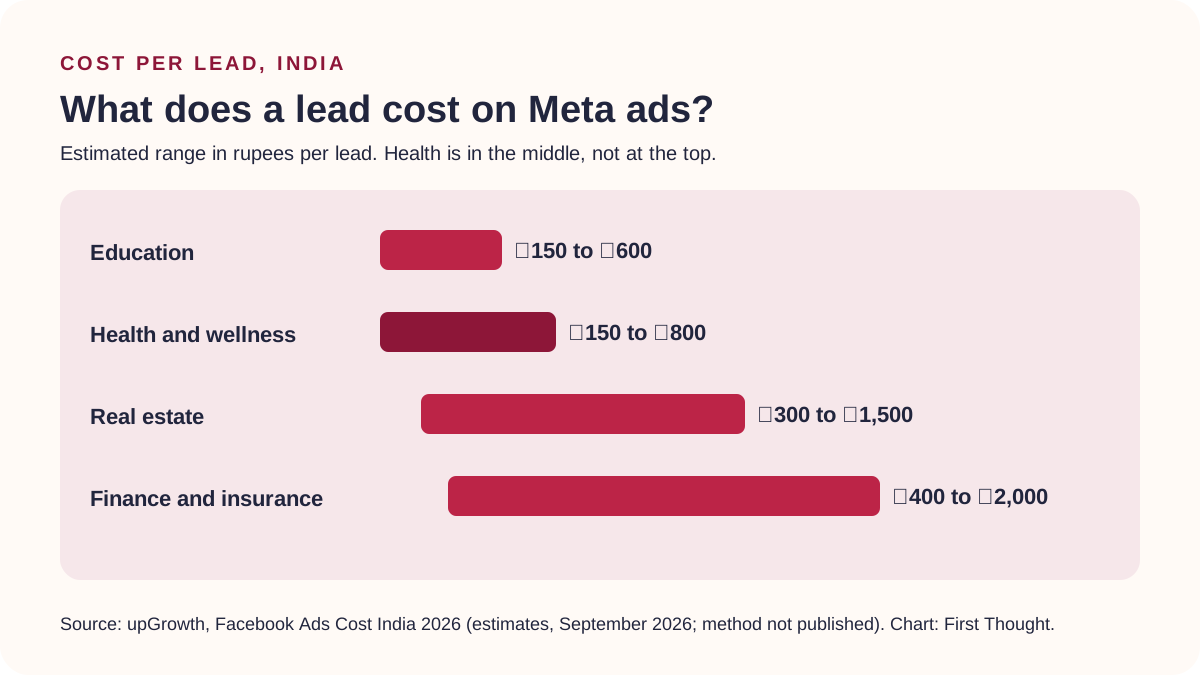
A Facebook or Instagram ad for a clinic in India costs whatever the auction charges for your audience, and the best public estimate for health and wellness advertisers is a cost per click of ₹5 to ₹20 and a cost per lead of ₹150 to ₹800. These are upGrowth's estimates for September 2026, and upGrowth does not publish its method or sample size.
Here is how the main cost terms work. CPM is the cost of 1,000 impressions. CPC is the cost of one link click. CPL, or cost per lead, is the cost of one enquiry form or messaging conversation started from your ad.
| Cost term | What it measures | upGrowth estimate, India, Sept 2026 | Where a clinic should look |
|---|---|---|---|
| CPM | Cost of 1,000 ad views | ₹60 to ₹250 (all industries) | Ads Manager, delivery columns |
| CPC | Cost of one link click | ₹5 to ₹20 (health and wellness) | Ads Manager, results columns |
| CPL | Cost of one lead form | ₹150 to ₹800 (health and wellness) | Lead form results |
| Cost per messaging conversation | Cost of one WhatsApp or Messenger chat started | ₹30 to ₹200 (all industries) | Ads Manager, messaging results |
The same page lists higher lead costs for finance and insurance (₹400 to ₹2,000) and real estate (₹300 to ₹1,500), so health sits in the middle.
How big is the audience a clinic can reach?
Large enough. DataReportal's Digital 2026: India report counts a Facebook advertising audience of 403 million and an Instagram advertising audience of 481 million in India in late 2025. These are ad reach estimates, not monthly active users. For a local clinic the real limit is how many people within 10 to 15 km, in the right age group, see your ad often enough to remember your name.
Why do published Facebook ad costs for India disagree so much?
Published numbers disagree because they come from different data sets, different years and different metrics, and most do not say which. A clinic owner who compares three blog posts will see three different answers.
Two examples show the problem. A Mega Digital guide dated July 2026 lists a healthcare CPC of ₹0.26, names no data source, and gives two conflicting cost-per-lead figures (₹0.75 and ₹54) on the same page. The upGrowth page above puts health CPC at ₹5 to ₹20.
A third source, Superads' healthcare benchmark page, shows a global healthcare cost per lead rising from $47.01 in July 2025 to $103.52 in July 2026. It covers all countries, not India, so it shows only that costs can move a lot in a year.
What to do with this: use the ₹150 to ₹800 range only to decide whether a test is worth starting, ask any agency where its number comes from, and replace every benchmark with your own numbers after the first month.
How much should a clinic spend on Facebook ads per month?
A practical minimum is about ₹10,000 a month, and most clinics need ₹20,000 to ₹50,000 to learn anything useful. upGrowth's budget guide lists ₹2,000 to ₹10,000 a month as a tiny test tier and ₹10,000 to ₹50,000 as the next tier, and says a practical minimum is about ₹333 a day.
Here is what those budgets buy at the ₹150 to ₹800 CPL range. This is simple division, not a promise.
| Monthly ad spend | Leads at ₹800 each | Leads at ₹150 each | What it can realistically do |
|---|---|---|---|
| ₹10,000 | About 12 | About 66 | One narrow test: one service, one area |
| ₹30,000 | About 37 | About 200 | Two or three services, two creatives each |
| ₹50,000 | About 62 | About 333 | A steady flow plus retargeting to past visitors |
Ad spend is only one part of the cost. A clinic also pays for creative (photos of the clinic and team, short videos), someone to reply to enquiries within minutes, and an agency fee if you hire one. We do not know a reliable public benchmark for agency fees in this sector, so ask for a written quote that lists exactly what is included. Our marketing budget worksheet shows how to set a total budget before splitting it by channel.
Why can a small budget cost more per lead?
Because Meta's system needs data to optimise. PPC Land reported on 21 October 2026 that Meta wrote that ad sets with fewer than roughly 50 conversions a week "ran about 28% more expensive per purchase". Meta gave no method for the 28% figure, but the 50-a-week threshold is long-standing guidance.
Do the arithmetic for a clinic. If one ad set is optimised for lead forms at ₹500 a lead, 50 leads a week costs about ₹25,000 a week, or roughly ₹1 lakh a month. A clinic spending ₹30,000 a month on that setup will stay in what Meta calls the learning phase most of the time.
Two ways to deal with that: run fewer ad sets, one per service, and optimise for a cheaper event such as a WhatsApp conversation (₹30 to ₹200 in upGrowth's estimate) instead of a form.
What is the number a clinic should actually track?
The number to track is cost per visit that happened, not cost per lead. A lead is a name and a phone number. A visit is a patient in your waiting room.
Here is an illustration with invented figures, not a benchmark. Suppose a clinic spends ₹30,000 in a month and gets 100 leads, which is ₹300 per lead and looks good. Suppose 60 of those leads can be reached on the phone, 30 book an appointment and 20 turn up. The cost per visit is ₹1,500, five times the cost per lead.
| Stage | Illustrative count | Cost at ₹30,000 spend |
|---|---|---|
| Leads | 100 | ₹300 per lead |
| Reached on phone or WhatsApp | 60 | ₹500 each |
| Booked appointment | 30 | ₹1,000 each |
| Visit completed | 20 | ₹1,500 each |
The drop between stages is where most clinic ad money is lost, and it is rarely the ad's fault. Slow replies, unclear fees, no WhatsApp booking and no reminder before the appointment each lose patients. Our article on Meta lead forms and lead quality and the guide on fixing the handoff before you scale cover the follow-up side in more detail.
Keep a sheet with four weekly columns: spend, leads, bookings, completed visits. After four weeks you have your own cost per visit, the only benchmark that matters for your clinic.
What do NMC's October 2026 advertising guidelines mean for clinic ads?
They mean a clinic's Facebook ad must stay factual. The National Medical Commission issued guidelines on ethical advertising and public communication by public notice dated 6 October 2026, and Medical Dialogues reports that they came into force with immediate effect. They apply to registered medical practitioners, to hospitals and medical institutions, and to healthcare platforms that list doctors.
We read the guidelines through press coverage. The official notice is a scanned PDF we could not read as text, so ask your advisor to read the original.
As reported, the guidelines prohibit:
- displaying before-and-after photographs or advertising surgical results;
- using patient testimonials or endorsements, even with the patient's consent;
- claims such as guaranteed cures, "best doctors" or "100% success", and comparisons that cannot be verified;
- any commission, referral fee or lead-generation payment tied to patient referrals;
- discounts and free procedures that encourage unnecessary care;
- fake or bought reviews, followers and ratings;
- AI-generated promotional campaigns for commercial interest, and any permitted AI content must carry a source mark saying it is AI-generated.
The South First's report adds that outsourcing to an agency or an influencer does not protect the doctor if the doctor authorised or knew about the content. In other words, the clinic stays responsible for what its agency posts.
What the guidelines allow, as reported, includes factual hospital information: name, location, contact details, departments, facilities, accreditation status and charges. Doctors may also announce a new practice or address change.
What are the penalties?
Medical Dialogues reports graded penalties decided by the State Medical Council after a show-cause notice: a warning and ethics training for a first violation, censure and a fine for a second, and suspension of registration from three months up to removal from the register for one to three years for serious or repeated violations. Hospitals are dealt with under the Clinical Establishments Act or state law.
Does this mean a clinic cannot run Facebook ads at all?
The reports we read do not say that. They restrict content and conduct, not the platform. The reports also do not say exactly how paid advertising by clinics is treated, so a clinic should get its advisor's view before running any ad.
In our reading, the safe side is factual and useful: services, timings, location, fee if you state it, how to book, and educational posts. The risky side is anything that promises, compares, shows results or uses a patient's face or story.
What does Meta's own health ad policy restrict?
Meta has its own rules, separate from the NMC's, and an ad must pass both. Meta's health and wellness advertising standard says, among other things:
- Ads for cosmetic products, procedures and surgeries must target people aged 18 or above. So must sexual and reproductive health services such as contraception and family planning. Dental products such as teeth whitening are among the exemptions listed.
- Ads may not claim to cure, heal or eliminate listed incurable or terminal conditions such as diabetes, cancer or HIV. Claims about managing symptoms are allowed.
- Wrinkle-treatment ads (Botox, fillers) and weight-loss ads may not show side-by-side comparisons.
- Ads may not create negative self-perception or make statements of inferiority about appearance, body parts or hygiene.
The page shows versions from July 2026 and December 2024 that word the self-perception rules differently, so check the live page before you submit ads.
For clinic ads, the useful consequence is that the NMC rules are stricter than Meta's in several places. Meta allows before-and-after for some cosmetic procedures, but the NMC guidelines, as reported, bar before-and-after photographs by doctors. When the two disagree, follow the stricter one.
What about ASCI?
ASCI's rules apply to clinic ads too. Its healthcare guidelines on awards and rankings, in force since 1 February 2020, require the award to come from a credible, independent body and the ad to name the body and the month and year. If your ad says "award-winning clinic", keep that paperwork.
How should a clinic pay an agency for Meta ads?
A clinic should pay a flat monthly fee for defined work, not a fee per lead or per patient. The NMC guidelines, as reported by Medical Dialogues, ban any commission, referral fee or lead-generation payment tied to patient referrals. The reports do not explain how a per-lead agency fee is treated, but a per-patient or percentage-of-revenue fee looks like exactly what the rule is aimed at.
Put four things in writing before you sign: what the flat fee covers, that the ad account and pixel are yours, that you approve every ad and claim before it goes live, and that weekly reports show booked and completed visits, not only leads.
Example: a three-doctor clinic in Bareilly plans a 30-day test
This is a hypothetical example to show the method. It is not a First Thought client result.
A clinic with a physician, a paediatrician and a dermatologist wants more bookings from within 12 km. It has a Google Business Profile and a WhatsApp number, but no ad history.
- Budget: ₹30,000 ad spend for the month, plus a separately agreed flat fee.
- Structure: two ad sets, "child fever and vaccination reminders" for parents and "skin consultation" for adults. Cosmetic services are left out, which avoids the 18+ procedure rules.
- Objective: WhatsApp conversations, a cheaper event that helps Meta exit learning.
- Creative: factual. A short clinic video with timings, fee and location, and an educational reel by the doctor. No patient stories, no before-and-after, no "best" claims.
- Follow-up: a reply within 10 minutes in clinic hours, a slot offered, a reminder the evening before, and a record of who came.
- Review at day 30: cost per conversation, per booking and per completed visit.
The design matters more than the rupee figures: few ad sets, a cheap event, factual ads and a record of visits.
Step by step: how to launch a clinic ad test safely
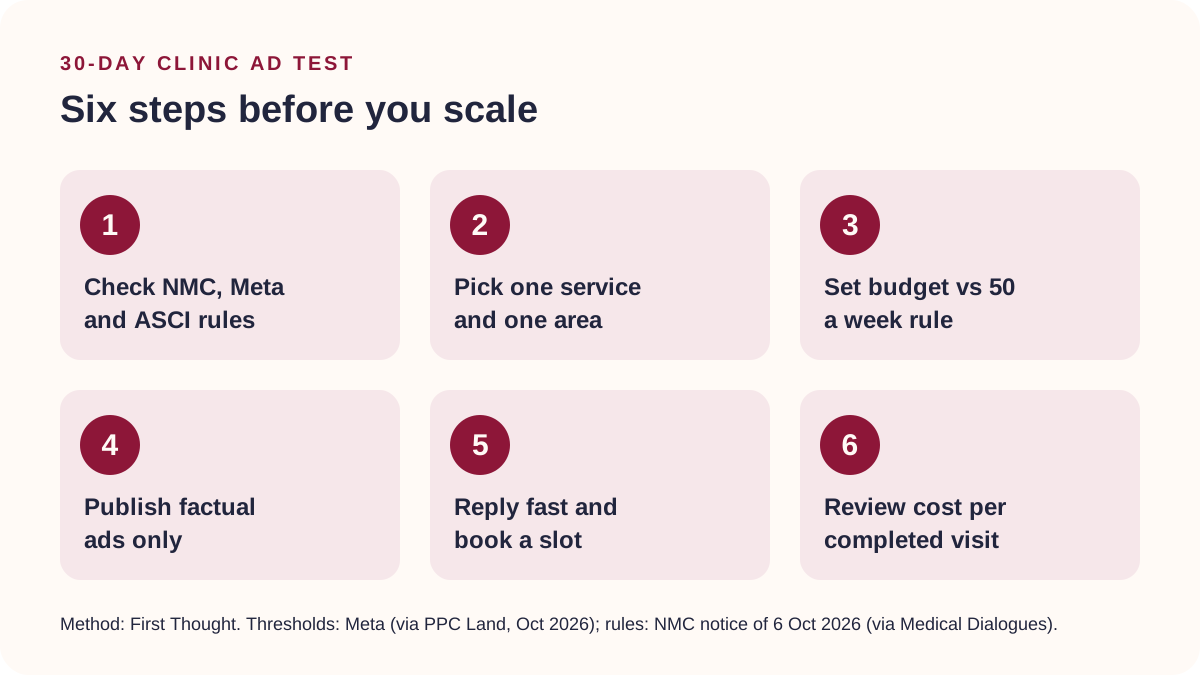
- Read the rules. The NMC notice of 6 October 2026, Meta's health standard and ASCI's healthcare guidance, or have your advisor do it.
- Pick one service and one area, for example one speciality within 10 km.
- Set the budget against the 50-a-week rule, or choose a cheaper event.
- Write factual ads: services, timings, location, how to book.
- Fix the reply system: WhatsApp Business, a named person, booking slots.
- Review after 30 days on cost per lead, booking and visit.
Common mistakes to avoid
- Judging by cost per lead. A ₹200 lead that never turns up costs more than a ₹600 lead who books.
- Using patient photos or stories. Under the NMC guidelines as reported, consent does not make a testimonial acceptable.
- Posting before-and-after results. Meta limits them for several treatments and the NMC bars them for doctors.
- Splitting a small budget across many ad sets, which keeps every ad set short of the 50-conversion threshold.
- Letting an agency post without your approval. The clinic stays responsible.
- Paying per lead or per patient, which the NMC rule on referral and lead-generation payments makes risky.
For the channel choice, see our guide on Google Ads versus Meta Ads for local leads.
A practical next step
First Thought, a digital marketing and creative agency in Bareilly, Uttar Pradesh, works with hospitals, clinics and other local businesses on lead generation, creative and follow-up systems. For healthcare clients we work to a flat fee and keep every ad within NMC, ASCI and Meta rules: no testimonials, no outcome claims, no guarantees. We start with your numbers, not a template, and set up tracking so you can see booked and completed visits. See our healthcare marketing page, our performance marketing service or contact us for a free audit of your current ads and enquiry handling. We will tell you if your budget is too small for paid ads to teach you anything yet.
Frequently asked questions
How much do Facebook ads cost for a clinic in India?
Plan for a cost per lead of about ₹150 to ₹800 and a monthly ad spend of ₹10,000 to ₹50,000, based on upGrowth's September 2026 estimates, which publish no method. Your real cost depends on city, speciality, creative and how fast you reply. Track cost per completed visit after 30 days.
What is a good cost per lead for a clinic in India?
There is no verified official benchmark. upGrowth estimates ₹150 to ₹800 for health and wellness in 2026. A better test is cost per completed visit: a lead that books and attends at ₹600 beats a ₹200 lead that never answers the phone.
Can doctors in India run Facebook ads under the NMC rules?
The NMC's 6 October 2026 guidelines, as reported, restrict what advertising may say: no testimonials, before-and-after photographs, guarantees or superiority claims, and factual information is allowed. The reports do not give a blanket ban on paid ads. Ask your advisor to read the original notice before you run any campaign.
Can a clinic use patient testimonials or before-and-after photos in Meta ads?
No, under the NMC guidelines as reported. They bar testimonials even with patient consent, and before-and-after photographs by doctors. Meta also limits side-by-side images for weight loss and wrinkle treatments. When the two disagree, follow the stricter rule.
How long should a clinic run a Meta ad test before judging it?
Run it for at least 30 days with a stable budget. Meta's guidance expects roughly 50 conversions per ad set per week to exit the learning phase, which a small clinic may not reach. Judge on bookings and completed visits, not on the first week's clicks.
Is it legal to pay an agency per lead or per patient?
Be careful. As reported, the NMC guidelines ban commissions, referral fees and lead-generation payments tied to patient referrals. The reports do not explain how per-lead agency pricing is treated, so a flat monthly fee is the safer structure. Ask your legal advisor before agreeing any variable fee.
Should a clinic use Facebook ads or Google Ads?
Many clinics test both. Google ads reach people who are already searching, while Meta ads reach people as they scroll. Which gets cheaper visits depends on your speciality and city, so start with one, measure completed visits, then compare.
Sources and further reading
DataReportal: Digital 2026: India ↗upGrowth: Facebook Ads Cost India 2026 ↗Mega Digital: How much does Facebook Ad Cost in India? [Updated 2026] ↗Superads: Facebook Ads Insights Tool: cost per lead, healthcare ↗PPC Land: Meta says ad sets under 50 weekly conversions cost 28% more per purchase ↗Medical Dialogues: NMC issues ethical advertising, public communication guidelines for doctors, hospitals ↗The South First: Doctors on Instagram: NMC says no to patient testimonials, paid ads, AI promotions and guaranteed claims ↗Meta: Health and wellness ↗Legal 500 / Mondaq: ASCI releases guidelines for usage of awards and rankings in healthcare advertisements ↗The frameworks here are our own recommendations. Any example is an illustration, not a client result.