
## The short answer
## ## The short answer
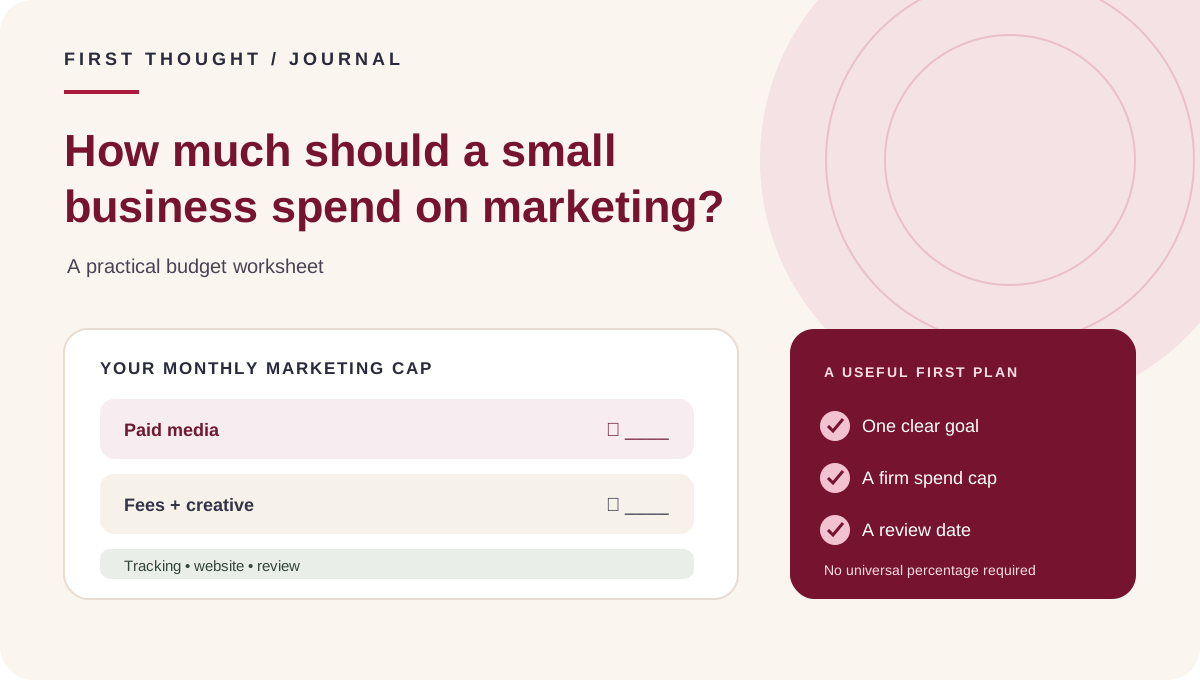
There is no single monthly amount or revenue percentage that fits every small business. Set a marketing budget by starting with what the business can afford after operating commitments, defining the result it needs marketing to support, and listing every cost required to do the work. Then run a bounded test with a clear cap, tracking method and review date.
Keep advertising spend separate from agency or freelancer fees, creative production, landing-page work, software and applicable taxes. A low media budget does not make those other costs disappear. Do not raise spend because a generic article says your business should spend a fixed share of revenue. Use your own margins, sales capacity and recorded outcomes.
Why a generic marketing percentage can mislead
## Why a generic marketing percentage can mislead
A revenue percentage is quick to calculate, but it can hide important differences. A new business with little predictable revenue, a seasonal retailer, a clinic with limited appointment capacity and an established service company do not have the same cash flow, margins, buying cycle or growth goal. The same percentage can produce very different cash amounts, and that amount may be too small or too large for the work being considered.
Benchmarks are easy to misread because sources define “marketing” differently. Before relying on a number, check country, year, sample and whether it includes fees, staff, events or paid media. A published rupee amount is not automatically an India-wide market average; search volume also says nothing about what one business can afford.
List the costs your marketing budget needs to cover
## List the costs your marketing budget needs to cover
Write down the full cost of the plan before choosing a channel. These categories prevent a common planning error: treating the platform payment as the whole marketing budget.
| Cost line | What to include | Keep it separate from |
|---|---|---|
| Paid media | Amount billed by the advertising platform for eligible campaigns | Agency, freelancer or production fees |
| Strategy and management | Planning, campaign setup, optimisation, reporting and coordination fees | Media amount billed by the platform |
| Creative and content | Copy, design, photography, video, editing, usage rights and necessary revisions | Existing reusable assets that require no new spend |
| Website and landing pages | One-off build work, hosting or maintenance, page updates and form improvements | Ongoing ad spend |
| Measurement and tools | Analytics setup, call or form tracking, CRM seats and tools needed for measurement | Platform results not verified against business records |
| Business time | Optional internal hours for approvals, follow-up and reporting; record it even when not paid | Cash expenses, so the workload is visible |
| Applicable taxes and fees | Taxes, payment charges or vendor expenses confirmed for your situation | Any quote that excludes them |
Ask providers to state whether proposals include platform spend, tax, creative production, landing pages, tracking and reporting. If two proposals define scope differently, their headline monthly totals are not directly comparable. Our marketing budget proposal guide has a checklist for comparing scope and responsibilities.
Calculate the affordable ceiling first
## Calculate the affordable ceiling first
Begin with a conservative ceiling: the maximum cash the business can commit for the period without putting essential operations, payroll, inventory, debt payments or customer service at risk. Use figures from the business’s own records and ask its accountant or finance adviser about cash-flow and tax questions.
Then check whether proposed acquisition economics make sense. For a repeat-purchase business, contribution after product, delivery, discounts and service costs matters more than gross sales alone. For a service business, include the time and capacity needed to serve a new customer. If reliable historical data exists, compare fully loaded acquisition cost with the contribution and payback period the business can support. If it does not, mark the unknowns and treat the first campaign as a learning test, not a proven growth engine.
Do not count projected revenue as available cash before the business receives it. Do not use a high customer lifetime value assumption unless repeat purchases, margin and retention are recorded. If you cannot explain how the maximum budget was set, lower the cap until you can.
Build the monthly marketing budget from the goal upward
## Build the monthly marketing budget from the goal upward
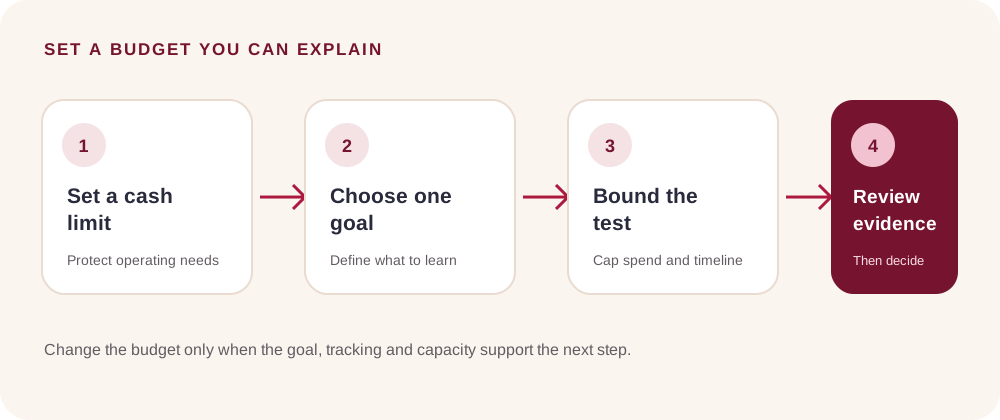
Use this sequence to turn the ceiling into a plan:
- Name one business goal. Examples include getting more qualified enquiries for a particular service, generating bookings for a confirmed offer, or understanding whether a defined audience responds to a message. “Get more visibility” is too vague unless you decide what signal matters and how it will inform a decision.
- Define the outcome and capacity. State what counts as a qualified enquiry, booking, order or other result. Check that staff, stock, appointment slots and follow-up time can handle the response.
- List the required work. Write down the people, creative, website changes, tracking and platform spend needed. Separate one-time setup from recurring costs.
- Subtract committed costs from the ceiling. The remainder is potentially available for a test or additional work. If there is no responsible remainder, do not borrow from essential operating cash to make a campaign look active.
- Choose one test and its stop conditions. Set a maximum spend and a time window that match the buying cycle and available evidence. Decide what would make you pause, investigate, continue or propose a change.
- Reserve time to review. Give someone ownership of checking spend, tracking, enquiry quality and operational capacity. Budget for the work needed to learn, not only the amount sent to an ad platform.
Choose an approach that matches the business stage
## Choose an approach that matches the business stage
| Business situation | A sensible starting approach | Avoid |
|---|---|---|
| New offer or limited history | Protect a cash ceiling, make tracking usable and fund one narrow test the team can fulfil | Spreading a small amount across many channels before learning anything |
| Enquiries arrive but quality is unclear | Record source and outcome, review the handoff and test one improvement | Scaling on clicks or low cost per lead alone |
| A channel has reliable, attributable outcomes | Check margin, payback, service capacity and delivery before increasing gradually | Assuming last period will repeat or every attributed conversion is incremental |
| Demand is seasonal or capacity is capped | Plan dates, availability, pauses and a reserve for approved changes | Keeping spend on when the business cannot serve demand |
If the business is not ready to measure a channel, it can still invest in foundation work such as a clear service page, accurate business information or useful content. Label that work by purpose and review point. Do not disguise a long-term foundation cost as a short-term lead-generation result.
Keep Google Ads media budget separate and understand billing rules
## Keep Google Ads media budget separate and understand billing rules
The budget entered in an advertising account controls media delivery; it does not include outside management or creative fees. Google Ads describes an average daily budget as an amount set per campaign. For most campaigns, daily spend can go up to twice that average daily budget, while the monthly spending limit is usually the average daily budget multiplied by 30.4. Check current campaign settings and Google’s official budget and spending-limit guidance before setting a cap, because campaign types and billing rules can vary.
That delivery flexibility is one reason to write down the maximum monthly amount, not just a daily figure. Review actual billed costs in the account and agree who is authorised to change budgets. A media cap should be visible to both the business and the person managing the campaign.
For Meta or another platform, check current budget controls; delivery, attribution and conversion definitions differ.
Set up tracking before spending more
## Set up tracking before spending more
A useful marketing budget answers not only “how much did we spend?” but also “what did the business learn or receive?” Define the event that matters, check that it is recorded correctly, and connect it to a real follow-up or sales process where possible.
For website campaigns, use consistent campaign tags and test the landing page. Google Analytics documents campaign URL parameters such as utm_source, utm_medium and utm_campaign in its campaign URL guidance. Do not put personal or confidential information into a tracking URL. Distinguish traffic-source reports from business outcomes; an attributed visit is not automatically an incremental sale.
For organic search, Google Search Console’s Performance report reports search clicks and impressions. Those measures help assess search visibility, but they do not include every marketing expense or prove that a click became a qualified customer. Pair platform data with enquiry, booking or order records where consent and tracking make that comparison appropriate.
Our small business marketing report template explains how to define a reporting period, source and denominator.
A fill-in worksheet for your first budget
## A fill-in worksheet for your first budget
Copy this table into a spreadsheet and use current business records. Leave a cell marked “unknown” if the amount or outcome is not verified; do not fill it with a market average.
| Planning question | Your entry |
|---|---|
| Period and business goal | ______________________________ |
| Maximum cash available after operating commitments | ₹ __________________________ |
| One-time setup needed this period | ₹ __________________________ |
| Monthly service or management fees | ₹ __________________________ |
| Creative and content costs | ₹ __________________________ |
| Website, tracking and tool costs | ₹ __________________________ |
| Taxes or payment fees confirmed by providers | ₹ __________________________ |
| Proposed paid media cap | ₹ __________________________ |
| Total committed marketing cost | ₹ __________________________ |
| What counts as a useful result? | ______________________________ |
| Who records enquiry quality or sales feedback? | ______________________________ |
| Test end date and review owner | ______________________________ |
| Pause or change condition | ______________________________ |
Compare the total with the cash ceiling. If it is higher, reduce scope or wait. Mark one-off and recurring costs.
When to keep, change or pause a marketing budget
## When to keep, change or pause a marketing budget
Review the plan against conditions written before launch. Consider keeping a test within its cap when tracking works, the business can handle the response and the test is still within its learning window. Change one material factor at a time when evidence identifies a specific issue, such as the wrong audience, unclear offer, weak landing page or slow follow-up.
Pause when spend exceeds the agreed limit, tracking is unreliable, terms are wrong, the business cannot deliver the offer, or enquiries are not being reviewed. If results are inconclusive because the sample is too small or the buying cycle is longer than the test, report that honestly. “Not enough evidence yet” is a valid outcome.
Increase a budget only when the business has a documented reason, enough capacity, a clear maximum and a review plan. There is no guarantee that a successful prior period will repeat.
Frequently asked questions
## Frequently asked questions
What percentage of revenue should a small business spend on marketing?
There is no universal percentage that fits every business. A benchmark is useful only when its source, country, year, sample and definition of marketing are clear. Start with an affordable cash ceiling, the goal, margin and operational capacity, then compare recorded outcomes.
How much should a small business spend on digital marketing in India?
There is no verified India-wide amount that can be recommended for every small business here. Costs differ by market, offer, objective, channel, production needs and location. Use actual quotes and your business’s own records; do not treat an unverified rupee range as a standard.
Does a marketing budget include advertising spend and agency fees?
Show both as separate lines. Advertising spend is paid to the platform; management fees pay for agreed services. Creative, landing-page work, tracking, tools, taxes and internal time may also matter. Ask the provider to define every included and excluded cost.
Can a small business run ads with a small budget?
Possibly, if the goal and test are narrow, the amount is affordable, the offer is ready and the business can measure a useful signal. A small budget spread across many campaigns may be hard to interpret. Do not promise a result before the audience, offer, market and tracking are understood.
A practical next step
## A practical next step
Use the worksheet to calculate an affordable ceiling and list the full cost of one marketing test. Confirm who approves spend, handles enquiries and records whether the activity was useful. Review First Thought’s performance marketing service and approach, or send an enquiry.
Sources and further reading
## Sources and further reading
- U.S. Small Business Administration: How to Get the Most From Your Marketing Budget — general planning material from a U.S. agency; not an India spending benchmark.
- U.S. Small Business Administration: Marketing plan example — a planning structure, not a rupee recommendation.
- Google Ads Help: Budgets overview — official spending-limit explanation.
- Google Analytics Help: URL builders and UTM parameters — campaign tagging guidance.
- Google Search Console Help: Performance report — search clicks and impressions.
- First Thought: Marketing budget proposal guide
- First Thought: Small business marketing report template
Search metrics note: Google Search Console query data and Google Keyword Planner volumes were not connected. Keyword selection reflects the question wording and public results reviewed on 18 October 2026; no search volume or ranking position is claimed.
Sources & further reading
U.S. Small Business Administration: How to Get the Most From Your Marketing Budget ↗U.S. Small Business Administration: Marketing plan example ↗Google Ads Help: Budgets overview ↗Google Analytics Help: URL builders and UTM parameters ↗Google Search Console Help: Performance report ↗First Thought: Marketing budget proposal guide ↗First Thought: Small business marketing report template ↗Search volume, Search Console queries and rankings were not available for this article. Examples are not client results or budget recommendations.