The short answer
The WhatsApp Business API has no licence fee, but you pay three things: Meta's charge for each delivered message, a monthly or per-message fee to your provider, and 18% GST on both. In 2026, vendor guides put a marketing message at about ₹0.86 and a utility message at about ₹0.115, plus a provider fee from roughly ₹999 a month. A small business sending a few thousand messages typically lands in the low thousands of rupees a month.
Those rupee rates come from provider guides, because Meta's own rate-card files did not open for us. Check your provider's invoice before you budget; our calculations are worked examples, not quotes.
Key takeaways
- Meta has billed the WhatsApp Business Platform per delivered message since 1 July 2025, so the cost is driven by how many messages you send and of which type, not by a monthly licence.
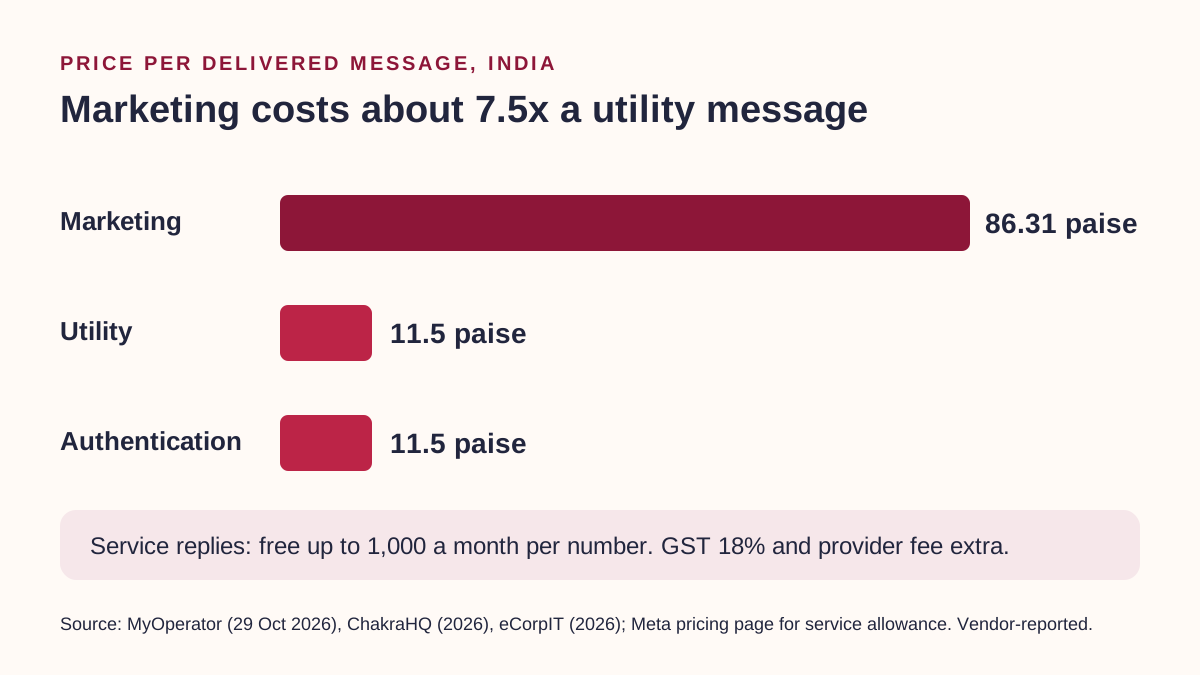
- Provider guides report India rates of about ₹0.8631 for a marketing message and about ₹0.115 for utility and authentication messages, which makes a marketing message roughly 7.5 times dearer than a utility one.
- From 1 October 2026 Meta charges for service messages beyond 1,000 a month per phone number, and for utility messages sent inside an open customer service window, so replies are no longer entirely free.
- The WhatsApp Business app is free and covers many shops, but its broadcast lists stop at 256 contacts, so a business that sends campaigns outgrows it.
- GST at 18% applies on top of both Meta's charge and your provider's fee, which is why the invoice is about a fifth higher than the list rates suggest.
What is the WhatsApp Business API, and is it free?
The WhatsApp Business API, which Meta now calls the WhatsApp Business Platform, is the version of WhatsApp that software can connect to. It lets a CRM, chatbot or automation tool send and receive messages for you. The API itself is not free: Meta charges for messages, and the company that connects you charges for its software.
These are two products. The WhatsApp Business app runs on your phone and is built, in Meta's words, "with the small business owner in mind" (WhatsApp Business, Business app, 2026). The API has no screen of its own: you use it through a provider's inbox, a chatbot or your own software.
Providers are called Business Solution Providers (BSPs). In India, AiSensy, Interakt, MyOperator, Gupshup and ChakraHQ sell API access with a dashboard, templates and chatbot tools. First Thought is not a BSP; we help businesses decide whether they need one and build the automation around it.
How does Meta charge for WhatsApp messages in 2026?
Meta charges per delivered business-initiated message, and the price depends on the message category. The per-message model replaced conversation-based pricing on 1 July 2025, and user-to-business messages are free (Meta, WhatsApp pricing, 2026).
There are four categories that matter:
| Category | What it is | Example | Charged? |
|---|---|---|---|
| Marketing | Promotions, offers, re-engagement | "Diwali sale starts Friday" | Yes, highest rate |
| Utility | Messages about something the customer already did | Order confirmation, appointment reminder | Yes, low rate |
| Authentication | One-time passwords | Login code | Yes, low rate |
| Service | Replies to a customer who messaged you, inside 24 hours | Answering "what are your timings?" | Free up to a monthly allowance |
Every message you send outside the 24-hour customer service window must be a pre-approved template. Meta requires each template to be filed as authentication, marketing or utility, and templates are reviewed automatically, with the review sometimes taking up to 24 hours (Meta, Template overview, 2026). The category sets the price, so filing a promotion as utility to save money is a compliance risk, not a saving.
What changed on 1 October 2026?
Service messages had been free since 1 November 2024. From 1 October 2026, Meta resumed charging per message for them, with the first 1,000 delivered service messages per business phone number each month free. Unused messages do not roll over, and charging starts at the 1,001st. Utility messages sent inside an open customer service window also became chargeable on that date (Meta, Updates to pricing, 2026).
A business answering a few hundred chats a month stays inside the free tier. One handling several thousand now pays for replies, so model it.
When can Meta change prices?
Meta says it may change pricing only on 1 January, 1 April, 1 July or 1 October, with at least one month's notice for rate-card changes and at least six months for changes to the pricing model (Meta, Updates to pricing, 2026). That gives you four dates a year to re-check your bill.
What are the actual rates in India?
Provider guides in 2026 report India rates of about ₹0.8631 per delivered marketing message and about ₹0.115 per utility or authentication message, and service messages free within the monthly allowance (MyOperator, updated 29 October 2026). The marketing rate rose from ₹0.7846, an increase of roughly 10%, when Meta raised India's marketing price on 1 January 2026 (ChakraHQ, 2026; Meta, Updates to pricing, 2026).
| Message type | India rate reported by providers (2026) | Notes |
|---|---|---|
| Marketing | about ₹0.8631 | Raised on 1 Jan 2026 from about ₹0.7846 |
| Utility | about ₹0.115 | Volume tiers can lower it |
| Authentication | about ₹0.115 | Authentication-international rate rose on 1 Apr 2026 |
| Service | ₹0 up to 1,000 a month per number | Charged from the 1,001st since 1 Oct 2026 |
Three separate provider guides give the same ₹0.8631 and ₹0.115 figures: MyOperator, ChakraHQ and eCorpIT. We still treat them as vendor-reported. Meta's pricing page links its INR list-rate files as CSV and PDF, and those files did not open for our checks. Meta's page confirms that INR billing is live and that India's marketing rate went up on 1 January 2026, but it does not print the amounts (Meta, WhatsApp pricing, 2026). Open the rate card in your Meta Business account or ask your provider for the current INR sheet.
One more date matters. Meta requires eligible India customers to move all messaging accounts to INR by 31 December 2026, and it stops delivering messages from non-INR accounts of eligible customers from 1 January 2027 (Meta, Updates to pricing, 2026). If you were billed in dollars through a provider, ask them when your account moves.
What do providers charge on top of Meta?
Providers charge either a monthly platform fee, a markup on each Meta message, or both. MyOperator's guide describes a per-message markup of ₹0.10 to ₹0.30 or a flat monthly fee of ₹999 to ₹9,999. ChakraHQ and eCorpIT quote a markup of 10% to 30%, and eCorpIT gives platform fees of about ₹999 to ₹16,999 a month (MyOperator, 2026; ChakraHQ, 2026; eCorpIT, 2026).
Each of those numbers comes from a company that sells the service, and none names the plans behind its range, so use them for budgeting, not for ranking providers. The structure matters more:
- Flat monthly fee, no markup. Predictable, and cheaper once you send many messages. MyOperator's guide puts the point where flat fees win at above about 10,000 messages a month.
- Per-message markup. A ₹0.20 markup on 10,000 messages adds ₹2,000 a month, the same guide's example.
- Extras. Ask about setup fees, chatbot-flow charges, agent seats and minimum top-ups.
AiSensy's guide for India lists plans from ₹1,500 a month and a marketing price of about ₹1.09, which shows how a provider's all-in per-message price sits above Meta's rate (AiSensy, 29 June 2026). That is a provider's own claim, so check it on their pricing page the day you sign.
How much does GST add?
GST adds 18% to Meta's charges and to your provider's fee, according to MyOperator and eCorpIT. If a business sends messages worth ₹10,000 at Meta's list prices, the GST bill on that alone is ₹1,800 before the provider's fee is counted (MyOperator, 2026; eCorpIT, 2026).
We found no tax-authority page on how Meta's charge is treated, so ask your CA whether you can claim input credit on the provider's invoice.
How much will a small business actually pay per month?
A business sending 500 marketing and 500 utility messages a month would pay about ₹1,756 all-in, and one sending 10,000 marketing and 5,000 utility would pay about ₹15,582. Both use the vendor-reported rates above, an assumed provider fee within the ranges quoted here (not a real plan), and 18% GST.
| Monthly volume | Meta charge | Provider fee (assumed) | GST at 18% | All-in total |
|---|---|---|---|---|
| 500 marketing + 500 utility | ₹489.05 | ₹999 | ₹267.85 | about ₹1,756 |
| 2,000 marketing + 1,000 utility | ₹1,841.20 | ₹1,499 | ₹601.24 | about ₹3,941 |
| 10,000 marketing + 5,000 utility | ₹9,206.00 | ₹3,999 | ₹2,376.90 | about ₹15,582 |
Method: marketing messages × ₹0.8631, plus utility messages × ₹0.115, plus the provider fee, then 18% on the total. This is First Thought's arithmetic on vendor-reported rates; your invoice will differ.
Example: a coaching institute in Bareilly
A coaching institute with 400 enrolled students wants to send fee reminders and test-schedule updates to parents, and a monthly offer message to old enquiries. Fee reminders and schedules are utility messages. The offer is marketing. If it sends 1,200 utility and 600 marketing messages a month, Meta's charge is about ₹138 plus ₹518, which is ₹656. With an assumed ₹999 provider fee and GST, the total is about ₹1,950 a month. That is an illustration, not a client result.
The split is the lesson: marketing is a third of the volume but about four fifths of Meta's charge. The 600 offer messages cost nearly four times as much as the 1,200 reminders.
How do you keep the bill low?
Move what you can into utility, use free windows, and stop messaging people who ignore you. Marketing is the expensive line, so the biggest saving is usually in sending fewer and better-targeted marketing messages.
- Send marketing only to people who opted in and replied before. Cold lists burn money and risk blocks.
- Keep genuine utility messages in the utility category. Order updates, appointment reminders and fee receipts belong there. Do not relabel a promotion as utility: Meta reviews categories, and a mismatch is a compliance problem, not a saving.
- Use the free entry point window. When a customer messages you from a Click-to-WhatsApp ad or a Facebook Page button, Meta opens a window in which marketing, utility, authentication and service messages are free. Meta's developer page says it may stay open up to 7 days, while the WhatsApp Business pricing page says 72 hours. We could not reconcile the two, so plan for the shorter one (Meta, WhatsApp pricing, 2026; WhatsApp Business, Platform pricing, 2026).
- Answer inside 24 hours. Replies inside the customer service window are service messages and sit in the free 1,000 a month.
- Review each quarter. Rates and rules can change on 1 January, 1 April, 1 July and 1 October.
If you run Meta ads that click through to WhatsApp, the free window is a real reason to link the two. Our guide to Google Ads vs Meta Ads for local leads helps you choose the channel, and the lead quality guide covers what to do with enquiries once they arrive.
Is the free WhatsApp Business app enough for your business?
For one shop or clinic where one to five people answer chats, the free app is usually enough. Move to the API when you need automation, a shared team inbox, or campaigns to more than a few hundred people.
| WhatsApp Business app | WhatsApp Business API (through a provider) | |
|---|---|---|
| Cost | Free to use | Meta per-message charges, provider fee, GST |
| Broadcast | Lists of up to 256 contacts who saved your number | Opted-in contacts, within Meta's messaging limits |
| Devices | One main phone plus up to four linked devices | Many agents through the provider's inbox |
| Automation | Greeting, away message, quick replies | Chatbots, CRM triggers, order and reminder flows |
| Best for | Single-location shops, solo professionals, small teams | Businesses with daily enquiry volume, campaigns or CRM |
The 256-contact list and five-device limits are from AiSensy's 2026 comparison (AiSensy, 29 June 2026), a provider that sells the API, so confirm the limits in the app itself. We found no official switch-over point, so treat it as a judgment call.
A simple test: if you lose enquiries because nobody replied in time, or cannot send a monthly reminder without copying numbers by hand, you have outgrown the app. If neither is true, stay on the free app and spend the money on ads and follow-up.
What are the hidden costs people miss?
The hidden costs are people and process. The message fee is the smaller part of a working WhatsApp system.
- Template work. Every outbound template needs writing, filing and approval. A rejected template means a delay.
- Setup and integration. Connecting the API to your website form, lead form or CRM takes time, and some providers charge for it.
- Staff time. Someone has to reply to the replies. An automated welcome message with no human behind it just annoys people.
- Consent and privacy. India's Digital Personal Data Protection Rules were notified on 14 November 2025. Rule 3, on the notice a business must give before it collects personal data, comes into force 18 months after publication, and it must be clear, in simple language, and say what data is processed and why (SCC Online, December 2025). Get a clear opt-in for WhatsApp messages now. This is general information, not legal advice.
How do you set up the API without overpaying?
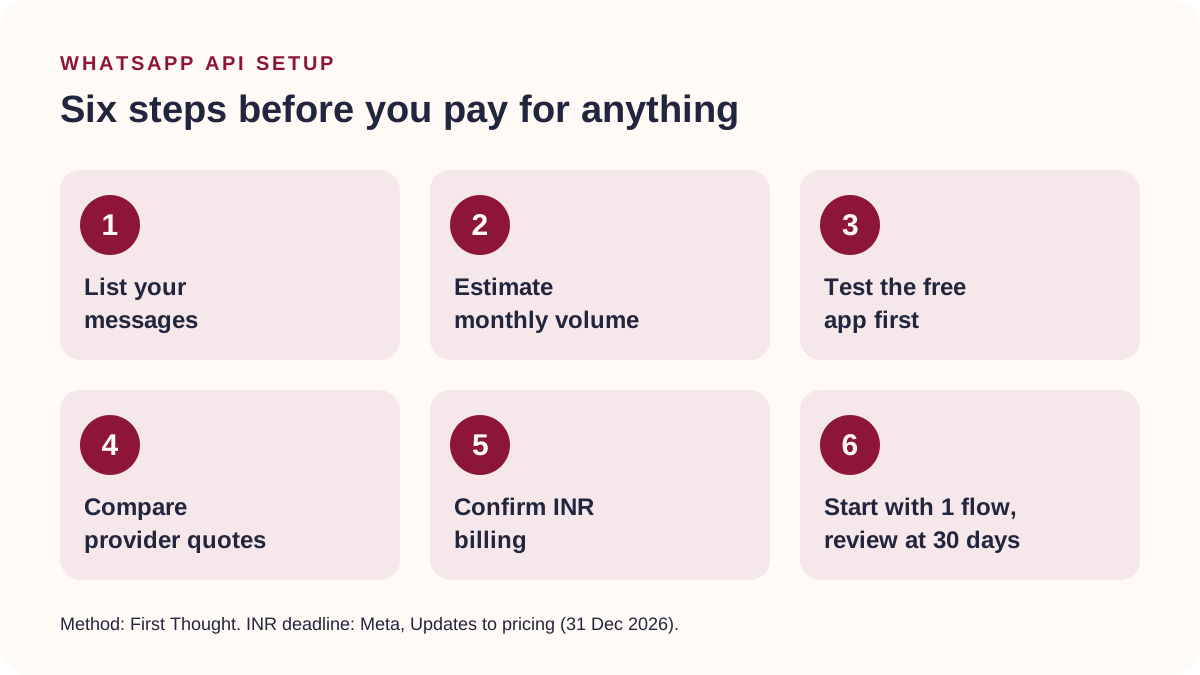
- List the messages you need. Five to ten: enquiry welcome, appointment reminder, fee receipt, offer, review request. Mark each marketing or utility.
- Estimate volume. Count enquiries and customers per month, then multiply by the messages per person. Use the table above.
- Check the free app first. If your list is under a few hundred and one or two people reply, stop here.
- Shortlist two or three providers. Ask each for the same quote: platform fee, markup, setup fee, agent seats, minimum top-up, contract length.
- Ask for the INR rate sheet. Make sure the account will be in INR before 31 December 2026.
- Start with one flow. For example, a welcome reply to Click-to-WhatsApp ad enquiries. Run it for 30 days.
- Review the invoice. Compare Meta's charge, the provider's fee and GST against your estimate. Adjust before adding campaigns.
Our post on your first automation should solve one real problem uses the same principle: pick one flow, and make it work before you add more.
Common mistakes to avoid
- Paying for the API when the free app would do. A fixed monthly fee for a business that sends 200 messages a month is money better spent on ads.
- Comparing providers on the monthly fee alone. A low fee plus a 30% markup can cost more than a higher flat fee, and GST comes on top of both.
- Labelling promotions as utility. It looks cheaper and puts your number at risk.
- Messaging a bought list. It invites complaints and blocks, and India's new data-protection rules point toward clear consent.
- Automating before you have a human reply process. A bot that collects 200 enquiries nobody answers makes the problem larger.
A practical next step
First Thought, a digital marketing and creative agency in Bareilly, Uttar Pradesh, builds the part around the message fee: the Click-to-WhatsApp ads that bring enquiries in, the welcome and reminder flows, and the follow-up process so enquiries get answered. We are not a WhatsApp provider and we do not resell Meta messages. We will look at your volume and tell you honestly if the free app is enough. See our automation services or contact us for a free review of your WhatsApp enquiry handling.
Frequently asked questions
Is the WhatsApp Business API free in India?
No. The API has no licence fee, but Meta charges per delivered business-initiated message by category, your provider charges a platform fee or markup, and 18% GST applies. The WhatsApp Business app on your phone is the free option, with smaller limits and basic automation.
How much does the WhatsApp Business API cost per month in India?
It depends on volume. At vendor-reported 2026 rates, 500 marketing plus 500 utility messages, an assumed ₹999 provider fee and GST come to about ₹1,756 a month; 10,000 marketing plus 5,000 utility come to about ₹15,582.
How much does a WhatsApp marketing message cost in India?
Provider guides report about ₹0.8631 per delivered marketing message in 2026, up from about ₹0.7846 after Meta's 1 January 2026 increase. Your provider adds a markup or platform fee, and GST of 18% applies, so your effective cost per message is higher. Confirm it on your invoice.
Are WhatsApp replies free now?
Partly. Since 1 October 2026 Meta gives each business phone number 1,000 free service messages a month and charges from the 1,001st. Replies to customers who message you from a Click-to-WhatsApp ad can also fall inside a free entry point window, lasting 72 hours or up to 7 days depending on the Meta page.
What is the difference between the WhatsApp Business app and the API?
The app is a free phone app for small teams, with broadcast lists of up to 256 contacts and basic auto-replies. The API connects WhatsApp to software through a provider, so it supports chatbots, CRM triggers, shared inboxes and larger campaigns, at a per-message cost.
Do I need a provider to use the WhatsApp Business API in India?
Most small businesses do. A provider gives you the inbox, template tools and billing, and handles the technical connection to Meta. Larger firms can integrate directly. Compare providers on platform fee, per-message markup, setup charges, agent seats and wallet rules, not on the monthly fee alone.
Can I send WhatsApp messages to anyone I have a number for?
No. Treat opt-in as required: India's data-protection rules are moving toward clear notice and consent. Send only to customers who agreed to hear from you, give an easy way to stop, and avoid bought lists. Ask your legal adviser about your case.
When should I re-check my WhatsApp API bill?
Quarterly. Meta says it changes pricing only on 1 January, 1 April, 1 July or 1 October, and it gives at least one month's notice for rate-card changes. Also check that your account moves to INR billing before 31 December 2026.
Sources and further reading
Meta for Developers: WhatsApp Business Platform pricing ↗Meta for Developers: Updates to pricing ↗Meta for Developers: Template overview ↗WhatsApp Business: Platform pricing ↗WhatsApp Business: WhatsApp Business app ↗MyOperator: WhatsApp Business API Pricing in India: What You're Actually Paying For in 2026 ↗ChakraHQ: How Much Does WhatsApp Business API Cost? Complete Pricing Guide (2026) ↗eCorpIT: WhatsApp Business API cost in India 2026: ₹0.8631 a marketing message, and the real bill ↗AiSensy: WhatsApp Business App vs WhatsApp Business API: [2026] ↗SCC Online: Digital Personal Data Protection Rules 2025 ↗The frameworks here are our own recommendations. Any example is an illustration, not a client result.