The short answer
To run Facebook ads in India, create a Facebook Page and a Meta Business account, add a payment method in rupees, then build a campaign in Meta Ads Manager: pick one objective, set a daily budget, choose your location and audience, upload one clear ad, and publish. Let it run at least seven days before changing anything.
The setup takes about an hour. What decides your results is the work around it: a clear offer, a working landing page or WhatsApp number, a budget big enough for Meta to learn, and someone who answers leads the same day.
Key takeaways
- A Facebook ad campaign has three levels in Meta Ads Manager: the campaign (your objective), the ad set (audience, budget and placements) and the ad (the creative people see).
- Meta advises running an ad for at least seven days, and an ad set is flagged "learning limited" when it is unlikely to get about 50 results in a week after its last significant edit.
- Public India benchmarks for September 2026 put cost per click at ₹4 to ₹50 and cost per lead at ₹150 to ₹2,000, so your own account data matters more than any guide.
- A boosted post is a shortcut inside the same ad system with fewer goals and no tracking of leads or purchases, so use Ads Manager when you want enquiries you can count.
- Most wasted budgets come from the same few mistakes: wrong objective, too many ad sets, constant edits, a weak landing page and nobody following up the leads.
What do you need before you run a Facebook ad?
You need five things: a Facebook Page for the business, a Meta Business account or Ads Manager access, a payment method that works in India, an offer a stranger can understand in one line, and a place to send people, such as a website page, a lead form or a WhatsApp chat.
The checklist:
- Page and profile. Add your business name, city, phone number, hours and a clear profile photo. People check the Page after they see an ad.
- Ads Manager access. Create or open your Meta Business account and confirm that you are the admin, not just an editor.
- Payment method. Add a card or another method Meta accepts for your account, and set the currency to INR so you plan in rupees, not dollars.
- One offer. "Free first class", "site visit this Sunday", "full-day trial" or "₹499 checkup" are offers. "Best quality services" is not.
- A working destination. Open it on your own phone on mobile data. If it loads slowly, or nobody replies to the WhatsApp message within a few minutes, fix that before you spend a rupee.
- A person who owns the leads. Name one person who contacts every lead the same day.
DataReportal's Digital 2026: India report says Meta's ad tools showed a Facebook advertising audience of 403 million and an Instagram advertising audience of 481 million in India in late 2025. These are ad reach estimates, not active users, so reach is rarely your problem. Showing the right message to people nearby is.
How do you run a Facebook ad, step by step?
You run a Facebook ad in eight steps: open Ads Manager, choose an objective, set a budget and schedule, define the audience, choose placements, build the ad, submit it for review, and then wait and read the results. The screens change often, so follow the logic below rather than the exact button names.
Step 1: Open Ads Manager and start a new campaign
Go to Meta Ads Manager and click Create. If you see a guided and a manual setup, choose manual: it shows all three levels.
Step 2: Choose the objective that matches the result you want
The objective tells Meta what to optimise for. Pick the one closest to the action you want, not the one that sounds biggest.
| If you want | Pick this objective | Good for | Watch out for |
|---|---|---|---|
| Phone calls or enquiry forms | Leads | Clinics, coaching centres, real estate, services | Low-quality forms if you ask too little |
| WhatsApp or Messenger chats | Engagement with a messaging goal, or Leads with chats | Retail, salons, local services | Chats that nobody answers |
| Website visits | Traffic | Content, early tests | Clicks that never become enquiries |
| Online orders | Sales | Shops with a working Pixel | Needs conversion data to work well |
| More Page followers or likes | Awareness or Engagement | Brand recall | Followers do not pay your bills |
Meta renames objectives from time to time, so read the table as intent. If unsure, pick Leads for a service business and Sales for an online shop.
Step 3: Set a daily budget and a schedule
Set a daily budget you can afford for at least seven days. Meta recommends running an ad for at least seven days so the system sees every day of the week, according to Relevant Audience's beginner guide dated 14 November 2026. Do not set an end date too early, and do not leave a campaign with no end date or spending cap if you are watching your cash.
Step 4: Define your audience
Start broad on interests and narrow on place. For a local business, choose your city and a radius, add an age range that fits your customer, and leave the rest open at first. A very narrow audience raises your cost per thousand impressions (CPM) and shows the same ad to the same people again and again, as the same Relevant Audience guide warns.
For Bareilly or Budaun, a radius of 10 to 15 km around the shop is a sensible first test. Widen it later using your own results.
Step 5: Choose placements
Leave placements on automatic for your first campaign. Switch to manual only when your data shows one placement wasting money.
Step 6: Build the ad
An ad has four parts: the visual, the first line of text, the headline and the button. Keep each one plain.
- Visual: one real photo or short vertical video of your work or shop, not stock images.
- First line: who it is for and what they get. "Coaching for Class 10 board students in Bareilly. Free demo class on Saturday."
- Headline: the offer in five to eight words.
- Button: Send message, Call now or Learn more, matching your objective.
Step 7: Submit the ad for review
Meta reviews ads before they show. Relevant Audience's guide says most reviews finish within 24 hours, attributing this to Meta. Common reasons for rejection in the same guide are exaggerated result claims, products in restricted categories, and destination pages that do not open or do not match the ad.
Step 8: Wait, then read the right numbers
After seven days, read results in this order: cost per result (cost per lead or per chat), then click-through rate, then CPM. If cost per lead looks good but sales do not follow, the problem is usually lead quality or follow-up, not the ad. Our guide on lead quality before scaling shows how to check this.
How much budget do you need to run Facebook ads in India?
Plan for at least about ₹10,000 a month for a serious test, or roughly ₹333 a day. Below that, upGrowth's September 2026 pricing guide recommends treating the spend as a test, not a verdict. Meta's own minimum varies by country and objective, and Ads Manager warns you if your budget is too low.
upGrowth gives two budget bands for small businesses: ₹2,000 to ₹10,000 a month for testing, and ₹10,000 to ₹50,000 a month for growth, which it calls the minimum for sustainable growth. These are the agency's guidance, not Meta rules, and upGrowth does not publish a sample size.
The same page quotes a Meta guideline for cost-per-result goals: a daily budget of at least five times your cost goal. A ₹500 cost-per-lead goal would need at least ₹2,500 a day.
Example: a coaching centre in Bareilly
This is an illustration with simple arithmetic, not a real client result.
A coaching centre wants admissions enquiries for Class 10 and 12 batches. Suppose its cost per lead lands at ₹300, which sits inside the ₹150 to ₹600 range upGrowth lists for education. The numbers then look like this:
| Monthly budget | Daily budget | Leads at ₹300 each | Leads per week | Reaches about 50 results a week? |
|---|---|---|---|---|
| ₹10,000 | ₹333 | about 33 | about 8 | No |
| ₹25,000 | ₹833 | about 83 | about 19 | No |
| ₹64,000 | ₹2,100 | about 213 | about 50 | Yes |
The lesson is uncomfortable but useful: a small local budget will usually keep an ad set in "learning limited" if you optimise for a rare action such as a purchase or a qualified lead. That does not mean the ad fails. It means you should keep one simple campaign, avoid splitting the money across many ad sets, and judge it on whether leads turn into admissions, not on Meta's learning label alone.
What does the learning phase mean, and why does it matter?
The learning phase is the period when Meta's system is still working out who responds to your ad. An ad set is flagged "learning limited" when it is unlikely to get about 50 results in the week after its last significant edit, according to Relevant Audience's November 2026 guide.
Meta put numbers on this in October 2026. PPC Land reported on 21 October 2026 that Meta wrote that ad sets with fewer than roughly 50 conversions a week "ran about 28% more expensive per purchase". The post gives no sample size, region, vertical or method, so treat 28% as Meta's claim, not a law. The direction is useful, though: spreading a small budget over many ad sets makes each one data-poor.
Three habits follow: use fewer ad sets (one campaign, one or two ad sets); make fewer edits, because a significant change restarts the learning count; and, if you cannot reach 50 results a week, optimise for a more frequent action such as a chat or form, then check lead quality by hand.
What do Facebook ads cost in India?
Public India benchmarks for September 2026 put cost per thousand impressions at ₹60 to ₹250, cost per click at ₹4 to ₹50 and cost per lead at ₹150 to ₹2,000. These are upGrowth estimates; the page says its CPM and CPC medians come from Superads India data.
The spread is wide because industries bid against each other differently. upGrowth's cost per lead ranges for four industries are shown below.
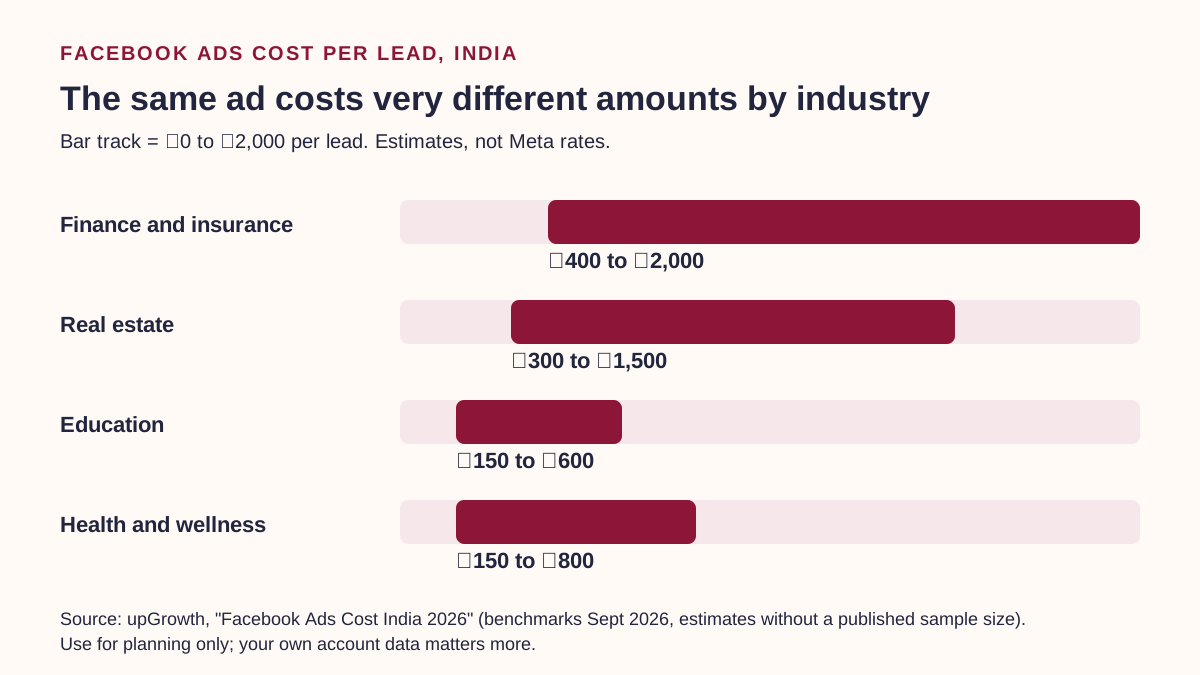
Use these ranges for planning only; your offer, city, season and creative change the result. Be careful with any single "average cost" online: Buffer's September 2026 guide, for example, still leans on a WordStream cost-per-click benchmark that appears to date from 2017 and is given only in US dollars. Our separate guide on Facebook ad costs for clinics goes deeper into one industry and shows how far public figures disagree.
Should you boost a post or use Ads Manager?
Use Ads Manager when you want enquiries or sales you can measure. A boost is a shortcut: it creates an ad from an existing post, through the same auction and billing as other ads, but hides the campaign and ad set levels and offers fewer goals.
Relevant Audience, in an article dated 12 October 2026, lists the differences. Here they are side by side.
| Boosted post | Ads Manager | |
|---|---|---|
| Structure | One screen | Campaign, ad set, ad |
| Editing creative after publishing | Not possible; text, image and video are locked | Possible at ad level |
| Goals | Narrower: profile visits, website visits, messages | Full set of objectives |
| Conversion tracking | Limited; suits engagement and messages | Meta Pixel and Conversions API for leads and purchases |
| A/B testing | Not built in | Available |
| Price | Same auction, no special price | Same auction |
Boosting suits a festival greeting. It is a poor way to learn which ad produces admissions or orders. For a deeper comparison of ad platforms, read our guide on Google Ads vs Meta Ads for local leads.
How do you track results from Facebook ads?
Track the action that makes you money, not just clicks. Install the Meta Pixel on your website if you have one, set up the lead or purchase event, and note how many leads become real customers. For WhatsApp-led businesses, keep a simple sheet with the source of each enquiry.
A basic setup has three layers: Meta's own numbers (cost per result, click-through rate, CPM, frequency), the Meta Pixel on your website with one event such as a form submit, and your own sheet with date, source, status and revenue for every enquiry. One person should compare the sheet with Ads Manager every week.
Relevant Audience's guide notes that the Pixel and Conversions API are prerequisites for Sales campaigns. Plan an hour for setup with your developer or agency. If you only run WhatsApp chats, the sheet is the tracking.
What do Indian advertising rules say about Facebook ads?
Your ad must follow Meta's ad policies and India's advertising code. The Advertising Standards Council of India (ASCI) Code says advertising claims must be truthful and honest, claims about verifiable facts must be capable of substantiation, and ads must not mislead through distortion, implication, omission, ambiguity or exaggeration.
In practice:
- Do not write "guaranteed results", "100% success" or "number 1" unless you can prove it.
- Keep the proof for every claim, such as a ranking, award or fee.
- If a creator or media handle posts your ad, the ASCI Code asks for a clear label such as "Advertisement", "Sponsored" or "Collaboration".
- Health, finance and education ads have extra rules. Doctors and hospitals should read the National Medical Commission's advertising guidelines before running any ad; our clinic guide summarises them.
Source: the ASCI Code, Chapter I, 2025.
What are the common mistakes to avoid?
The most common mistakes are choosing the wrong objective, editing the ad too often, splitting a small budget across too many ad sets, using a very narrow audience, leaving a campaign with no end date or cap, and sending clicks to a page that is broken or does not match the ad.
Relevant Audience's guide lists several of these, and they match what we see when we audit local accounts. Here is the list with the fix.
| Mistake | Fix |
|---|---|
| Objective does not match the goal | Pick Leads or Sales for enquiries and orders |
| Boosting every post | Use Ads Manager for offers |
| Too many ad sets | Start with one or two |
| Editing daily | Change one thing a week |
| Audience too narrow | Start with city plus radius |
| Ad promises more than the page | Make ad, page and offer say the same thing |
| No follow-up | Reply in minutes, not days |
| No end date or cap | Set one |
| Judging at day two | Wait seven days |
How do you know if your Facebook ads are working?
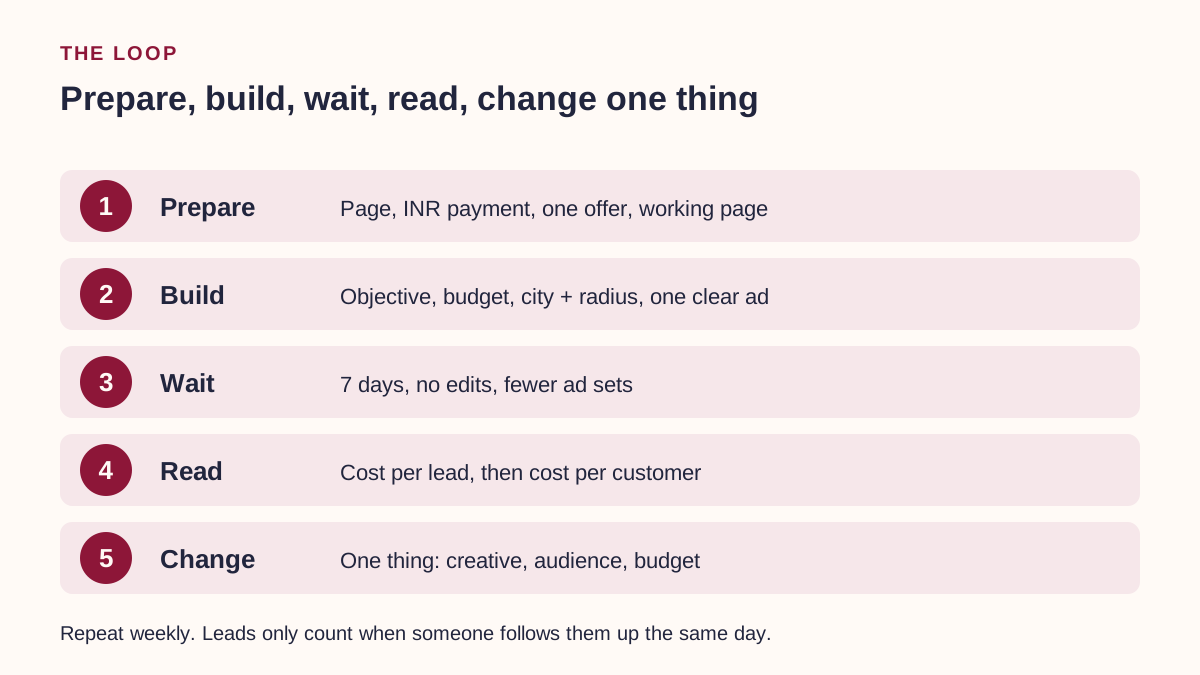
Your ads work if enquiries arrive at a cost you can afford and some of them become paying customers. Each week, write down spend, leads and customers, work out cost per lead and cost per customer, keep the ad with the cheapest customer (not the cheapest lead), and change one thing at a time: creative first, then audience, then budget. If leads come but customers do not, check reply speed, the offer and the form questions, in that order.
A practical next step
First Thought, a digital marketing and creative agency in Bareilly, Uttar Pradesh, runs performance marketing for local and online businesses: Meta Ads, Google Ads and lead-generation campaigns. We set up the account, the tracking and the creative, and we report on cost per lead and what happens to leads afterwards. We do not promise results, because auction costs and your offer both matter. If you would like someone to check your account or plan your first campaign, see our performance marketing service or contact us for a free audit.
Frequently asked questions
How do I run a Facebook ad for the first time?
Create a Facebook Page, open Meta Ads Manager, add a payment method in rupees, choose an objective such as Leads, set a daily budget, pick your city and radius, upload one clear ad and submit it for review. Then leave it for at least seven days before changing anything.
How much does it cost to run Facebook ads in India?
You can start with a small test budget, but upGrowth's September 2026 guide treats about ₹10,000 a month as a floor for a serious test. Reported costs per click range from ₹4 to ₹50 and cost per lead from ₹150 to ₹2,000, depending on the industry.
What is the difference between boosting a post and running a Facebook ad?
A boost creates an ad from an existing post using the same auction and billing, but through one simple screen with fewer goals and limited conversion tracking. Ads Manager gives you campaign, ad set and ad levels, Pixel tracking, exclusions and A/B testing. Use it for leads and sales.
How long should I run a Facebook ad before judging it?
Run it for at least seven days. Meta recommends this so the system sees every day of the week. An ad set is flagged "learning limited" if it is unlikely to get about 50 results in a week after its last significant edit. Avoid editing during this period.
What should I put in my first Facebook ad?
One clear offer, one real photo or short video, a first line that says who it is for, and a button that matches your goal, such as Send message or Call now. Write in the language your customers use, often Hinglish in Uttar Pradesh, and make sure the landing page repeats the offer.
Do Facebook ads work for small local businesses in Bareilly?
They can, if the offer is clear and someone follows up quickly. Local radius targeting lets a shop or coaching centre reach people nearby. Whether it pays depends on your margin, your cost per customer and the quality of your leads. Test with a small budget first.
Sources and further reading
- DataReportal, "Digital 2026: India" (2026) — https://datareportal.com/reports/digital-2026-india
- PPC Land, "Meta says ad sets under 50 weekly conversions cost 28% more per purchase" (25 Oct 2026, reporting Meta's 21 Oct 2026 post) — https://ppc.land/meta-says-ad-sets-under-50-weekly-conversions-cost-28-more-per-purchase/
- upGrowth, "Facebook Ads Cost India 2026" (updated 15 Nov 2026; benchmarks Sept 2026) — https://upgrowth.in/facebook-advertising-pricing/
- Relevant Audience, "How to Run Facebook Ads: A Step-by-Step Guide for Beginners" (14 Nov 2026) — https://www.relevantaudience.com/facebook-ads/how-to-run-facebook-ads-beginner-guide/
- Relevant Audience, "What Is a Boosted Post? Boost vs Ads Manager, Billing and Measurement" (12 Oct 2026) — https://www.relevantaudience.com/facebook-ads/what-is-a-boosted-post/
- Advertising Standards Council of India, "The ASCI Code, Chapter I" (2025) — https://www.ascionline.in/the-asci-code/
- Buffer, "How to Run Facebook Ads: 2026 Beginner's Guide" (16 Sep 2026) — https://buffer.com/library/facebook-ads-guide
Sources and further reading
DataReportal, "Digital 2026: India" (2026) ↗PPC Land, "Meta says ad sets under 50 weekly conversions cost 28% more per purchase" (25 Oct 2026) ↗upGrowth, "Facebook Ads Cost India 2026" (updated 15 Nov 2026) ↗Relevant Audience, "How to Run Facebook Ads: A Step-by-Step Guide for Beginners" (14 Nov 2026) ↗Relevant Audience, "What Is a Boosted Post? Boost vs Ads Manager, Billing and Measurement" (12 Oct 2026) ↗Advertising Standards Council of India, "The ASCI Code, Chapter I" (2025) ↗Buffer, "How to Run Facebook Ads: 2026 Beginner's Guide" (16 Sep 2026) ↗The frameworks here are our own recommendations. Any example is an illustration, not a client result.