The short answer
An AI agent is software that is given a goal and then decides its own steps to reach it, using tools such as your CRM, calendar, WhatsApp or spreadsheet. It reads the situation, plans, acts, checks the result and tries again. A chatbot only replies to messages. An agent also does the work behind the reply.
Most business agents today are not fully free-roaming. They work inside rules, on one job, with a person approving the risky steps. That narrow design is what makes them useful, and it is also where most failures start.
Key takeaways
- An AI agent is a system where a language model chooses its own next step and its own tools to reach a goal, while a fixed workflow follows steps written in advance by a developer.
- Every agent has the same five parts: a language model, a plan, memory, tools and a feedback loop that checks the result, which is why the same idea can run a WhatsApp enquiry desk or a daily sales report.
- Most small businesses should start with a fixed workflow or a narrow agent for one repeated task, because agents trade speed and cost for flexibility and can compound their own mistakes.
- Hype is ahead of results: Gartner expects more than 40% of agentic AI projects to be cancelled by the end of 2027, mainly because of cost and unclear business value.
- A simple test for an Indian business: if a task happens at least 20 times a week, its rules are written down and a mistake is cheap to fix, it is a good first job for an agent.
What is an AI agent in simple words?
An AI agent is a program that works toward a goal on its own by choosing which actions to take. You tell it what you want, not every step. IBM describes an AI agent as "a system that autonomously performs tasks by designing workflows with available tools", and Amazon Web Services says humans set the goal while the agent decides which actions to take (AWS, "What are AI agents?").
Think of a new office assistant. A script says "if the customer writes 'price', send the rate card". An assistant hears "Sharma ji wants a quote for 40 tiles and will visit on Saturday", looks up the stock, checks the price list, drafts the quote, books the visit and asks you only if something looks odd. An agent is built to behave like that second person, within limits you set.
How do AI agents work, step by step?
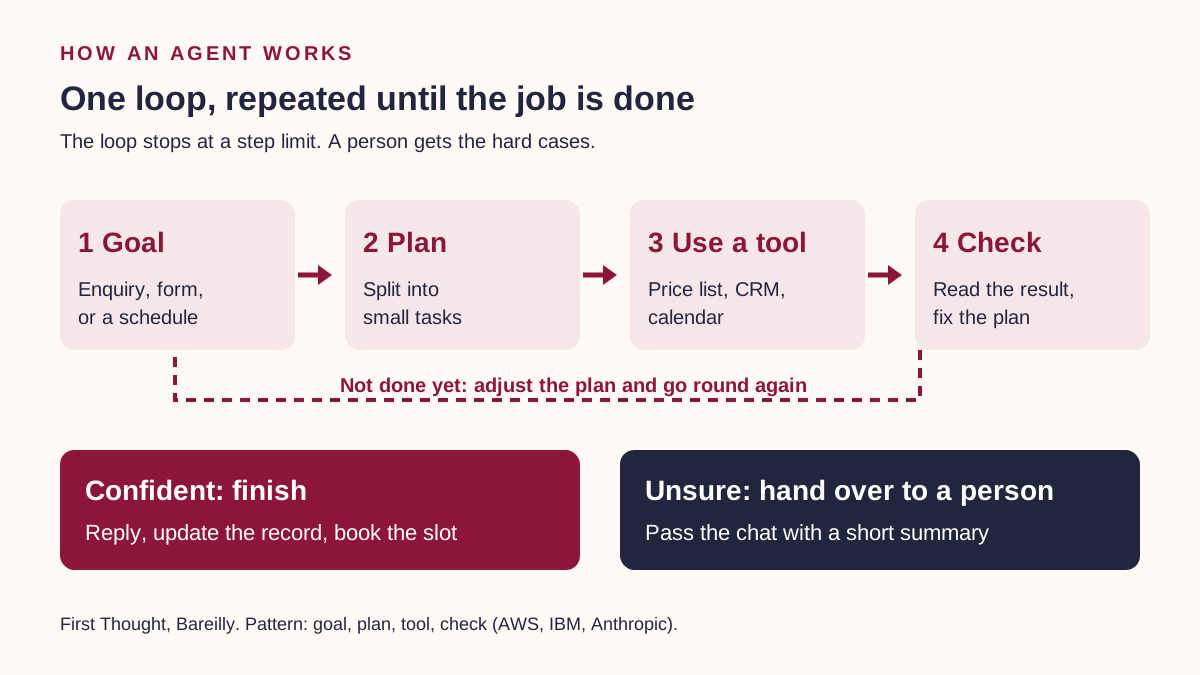
An AI agent works in a loop: it takes a goal, makes a plan, uses a tool, looks at the result and decides whether to continue, correct itself or stop. AWS describes three steps (set the goal, get the information, carry out tasks in order while checking progress) and IBM describes planning, reasoning with tools, then learning and reflection. In plain terms, the loop looks like this:
- Receive the goal. A customer message arrives, a form is filled or a schedule fires at 9 a.m.
- Plan. The language model splits the goal into small tasks. "Quote request" becomes: find the items, check stock, apply the price list, check the customer's location, draft the reply.
- Act with a tool. It calls a tool, for example reads the price sheet or searches the CRM.
- Observe. It reads what came back. If an item is missing, it changes the plan, for example by asking the customer which size they meant.
- Check and finish, or hand over. It compares the result with the goal. If it is confident, it replies or updates the record. If it is not, it passes the case to a person with the full context.
What is inside an agent?
AWS lists five components: a foundation model, a planning module, a memory module, tool integration, and learning and reflection. IBM names memory, planning and tools as the core. Here is what each means for a business owner.
| Part | What it does | Business example | What can go wrong |
|---|---|---|---|
| Language model (the brain) | Reads text, reasons, decides the next step | Understands a Hinglish message about delivery | Confident wrong answer if the facts are missing |
| Plan | Breaks the goal into steps | Quote request becomes five small tasks | Skips a step, or loops |
| Memory | Remembers the conversation and past cases | Knows this customer asked last week | Stale or duplicate records |
| Tools | Lets it act in other software | Reads price list, books a calendar slot | Wrong permission, wrong record changed |
| Feedback loop | Checks the result and corrects | Notices the stock item is out and offers another | Endless retries if no limit is set |
The practical point: an agent is only as good as the facts and tools you connect to it. A clever model with an out-of-date price list will give confident wrong quotes.
What is the difference between an AI agent, a chatbot and automation?
A chatbot replies, an automation follows fixed steps, and an agent chooses its own steps toward a goal. Anthropic, the company behind Claude, draws the line between two kinds of systems in its engineering guide Building effective agents (December 2024): workflows are "systems where LLMs and tools are orchestrated through predefined code paths", while agents are "systems where LLMs dynamically direct their own processes and tool usage".
Salesforce's India blog makes the same split for business buyers: chatbots "follow scripts" and traditional automation "requires pre-programmed workflows", while agentic AI "understands context, makes decisions, and takes actions" (Salesforce India, Feb 2026). Salesforce sells agents, so read this as a vendor's framing, but the three-way split is a useful one.
| Rule-based chatbot | Automation / workflow | AI agent | |
|---|---|---|---|
| Who decides the steps | You, in a script | You, in a flow | The model, within your rules |
| Handles messy input (Hinglish, typos, voice notes) | Poorly | Poorly | Well |
| Takes actions in other tools | Rarely | Yes, fixed ones | Yes, chosen as needed |
| Predictable | Very | Very | Less, needs testing |
| Cost to run | Low | Low | Higher (model calls each step) |
| Best for | Menu-style FAQs | Same steps every time | Varied tasks where the path changes |
Anthropic's advice is to look for "the simplest solution possible" and add complexity only when needed. It also warns that agentic systems "often trade latency and cost for better task performance" and bring "the potential for compounding errors". For a small business, that translates into a rule: if a fixed flow can do the job, use the flow.
What are the main types of AI agents?
Textbooks list five types, from simplest to most advanced: simple reflex, model-based reflex, goal-based, utility-based and learning agents. IBM and AWS both use this list, and AWS adds hierarchical agents and multi-agent systems.
| Type | How it decides | Everyday example |
|---|---|---|
| Simple reflex | Fixed "if this, then that" rules, no memory | Thermostat, "Hi" auto-reply |
| Goal-based | Plans steps to reach a goal | Books a site visit that fits both calendars |
| Multi-agent | Several agents split the work | One agent reads the enquiry, another checks stock, a third drafts the reply |
Most business agents on offer are goal-based and use a language model to plan. The better buying question is "which job, with which tools, and who checks it?".
What can AI agents do for a business? (real examples)
Agents suit work that is repeated, rule-bound and tied to your own data. Sigosoft, an Indian software vendor, groups agent jobs into a four-rung ladder: Answer (from an approved knowledge base), Capture (turn messy input into structured data), Act (finish tasks inside your systems) and Coordinate (chain tasks across teams). It suggests starting at Capture and treating Coordinate as a second-year project (Sigosoft, updated 10 Nov 2026).
By team, the examples that vendors and Indian guides most often list are:
- Sales: answer an enquiry in minutes, ask the qualifying questions, add the lead to the CRM, book a call. Salesforce describes agents that qualify inbound leads against criteria such as company size, budget signals and urgency.
- Customer support: answer from your own FAQ and policies on WhatsApp or the website, and pass complex cases to staff with the conversation attached. In a Salesforce case study, the company aha reports about 60% of incoming queries resolved autonomously, across more than 5,000 daily queries. That is a vendor-published case, not an independent audit.
- Operations and finance: capture orders from WhatsApp into a sheet, send payment reminders with a person approving the wording, and send a daily briefing of sales and pending follow-ups.
Notice what is missing: negotiation, disputes, refunds above a limit and sensitive conversations such as health. Sigosoft's own advice is to keep these with people.
Example: a Bareilly furniture showroom
This is an illustrative scenario, not a First Thought client result.
A showroom in Bareilly gets 30 to 40 WhatsApp enquiries a day: "sofa set price?", "Saturday ko visit kar sakte hain?", "delivery Budaun tak hoti hai?". Two staff reply between customers, so evening messages are answered the next morning, when the buyer has already messaged a competitor.
| Step | Fixed automation can do it | A narrow agent adds |
|---|---|---|
| Price of a listed item | Only if the customer picks it from a menu | Finds the item from a typed description |
| Booking a showroom visit | Fixed slot form | Suggests a slot from free-text "Saturday evening" |
| Discount or custom size request | No | Passes it to the owner with the chat summary |
The first pilot would run one month on WhatsApp, with the ten most-asked questions and a person reading every answer. The owner then checks reply time and hand-overs. These numbers are assumptions, not results.
Which tasks should an Indian small business give an agent first?
Give an agent a task that is repeated, has written rules and is cheap to fix when wrong. Sigosoft's three-question test asks: does the task happen about 20 or more times a week, are the rules written down, and is a mistake cheap to fix? If any answer is no, a template, a spreadsheet or a ready-made tool is often cheaper.
Here is a short scoring checklist you can use on your own tasks. Score one point for each "yes".
- The task happens at least 20 times a week.
- A new staff member could do it from a written note.
- The data it needs (price list, stock, customer list) is in one place and up to date.
- A wrong answer can be corrected the same day without losing a customer.
- One named person will read a sample of the agent's work every week.
- You can say in one line how you will know it is working (for example, "reply within 5 minutes").
Six or five points: a pilot makes sense. Three or fewer: tidy the process and data first. The scoring is our own rule of thumb, not a published benchmark.
How common are AI agents in business right now, and do they work?
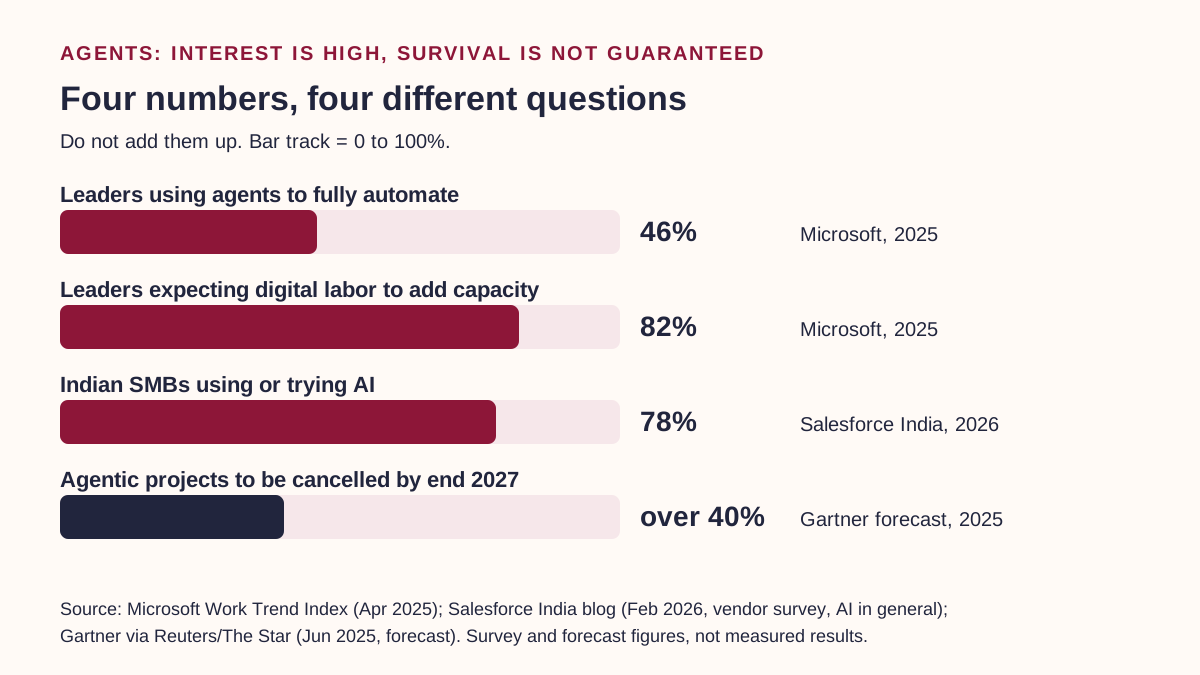
Adoption is real but early, and results are uneven. The numbers below measure different things, so do not add them up.
- Leaders using agents: Microsoft's 2025 Work Trend Index (23 April 2025) says 46% of leaders report their companies use agents to fully automate workflows or processes, and 82% are confident they will use digital labor to expand capacity in the next 12 to 18 months (Microsoft WorkLab, 2025). This is a survey of leaders, not proof of results.
- Cancelled projects: Gartner says more than 40% of agentic AI projects will be cancelled by the end of 2027 because of rising costs and unclear business value (Reuters via The Star, 25 June 2025).
- Agent washing: the same Gartner release says vendors relabel chatbots and assistants as "agentic" and estimates that only about 130 of the thousands of agentic AI vendors are genuine.
- Indian SMBs and AI in general: a Salesforce report cited in its India blog says 78% of Indian SMBs are using or experimenting with AI, (Salesforce India, Feb 2026). These are vendor-commissioned figures, and they cover AI broadly, not agents only.
- The gap between trying and scaling: Sigosoft cites a survey in which 57% of small businesses call AI core to growth but only 25% have integrated it, and Deloitte India research in which only 29% of firms could scale even 30% of their AI pilots (Sigosoft, Nov 2026). Sigosoft gives no year for the first survey, so treat it as indicative.
The honest reading: many companies are trying agents, a large share of projects will not survive, and the ones that do tend to be small, measured and owned by one person. Most agent explainers that rank on Google give no independent numbers at all, which is why we list our sources below.
What are the risks and limits of AI agents?
The main risks are wrong answers delivered with confidence, runaway loops, weak data, privacy exposure and nobody owning the agent. Each has a practical control.
- Compounding errors. Anthropic warns that autonomy brings higher costs and the potential for compounding errors, and recommends extensive testing in sandboxed environments with guardrails. Control: test on 50 real past messages first.
- Infinite loops. IBM notes agents can repeatedly call the same tools, so some real-time human monitoring may be needed. Control: set a maximum number of steps and a time limit, then hand over.
- Bad data. Sigosoft's list of failure causes starts with unwritten rules and poor data: duplicate customers, outdated prices and unlabelled stock lead to confident wrong answers. Control: clean the one source the agent reads before you launch.
- Privacy. IBM flags data privacy when integrations with business and customer systems are poorly managed. Control: ask any vendor where data is stored, and give the agent access only to the fields it needs.
- No owner. Sigosoft's advice is that each agent needs one person who reviews its conversations weekly. Control: name that person before you sign.
Regulated work needs extra care. If you run a clinic, a school or a financial service, an agent must never give medical, admission or investment advice on its own.
How do you start with an AI agent, in 30 days?
Start with one job, one channel and a person approving every output for the first month. A simple plan, adapted from the gated approach Sigosoft describes:
- Week 1: run the six-point checklist on three tasks, pick the best, and write its rules in one document.
- Week 2: build the smallest version: one channel, the ten most-asked questions, a clear hand-over trigger.
- Weeks 2 to 3: replay 50 real past enquiries and count the wrong answers.
- Weeks 3 to 4: run it with a person approving every reply, and note what they change.
- Day 30: review reply time, hand-over rate and complaints. Widen only if the numbers hold.
For build prices and monthly running costs in India, see our separate guide to AI agent development cost in India. If your agent will talk on WhatsApp, read WhatsApp Business API cost in India first, because messaging fees add a running cost that many quotes leave out. For choosing what to automate first in marketing, see your first marketing automation should solve one real problem.
Common mistakes to avoid
- Starting too wide. "Automate the whole office" fails more often than "answer pricing questions on WhatsApp".
- Buying an old chatbot with a new label. Gartner's agent-washing warning applies to Indian vendors too. Ask the vendor to show a case where the agent chose a different path on its own.
- Hiding the agent. Say it is automated and make it easy to reach a person.
A practical next step
First Thought, a digital marketing and creative agency in Bareilly, Uttar Pradesh, builds AI agents and automations for businesses across India, and runs parts of its own office on them. We begin with one job you do every week, show you what the agent would do on your own sample messages, and keep a person's approval in the loop. We do not promise a saving before we have seen your volume and your data. If you want a second opinion on a plan or a quote, message us on WhatsApp or use the contact page. See our AI agents service, our AI automation work for Bareilly businesses, or contact First Thought.
Frequently asked questions
What is an AI agent in one sentence?
An AI agent is software that takes a goal, decides its own steps using tools such as a CRM, calendar or messaging app, checks the result and either finishes the task or hands it to a person. It differs from a chatbot because it acts, not just replies.
How do AI agents work?
They run a loop: receive a goal, plan the steps, use a tool, read the result, and decide whether to continue, correct or stop. A language model does the reasoning, memory keeps context, and tools connect to your software. Good agents also hand over to a person when unsure.
What is the difference between an AI agent and a chatbot?
A rule-based chatbot follows a script and replies. An AI agent chooses its own next step to reach a goal and can act in other software, such as booking a slot or updating a record. Agents handle messy requests better but need more testing and cost more to run.
Is ChatGPT an AI agent?
By itself, a chat window is not an agent: it answers and does not act in your other software. When it is connected to tools, memory and a goal, and allowed to take actions, it becomes part of an agent. The same model can power a chatbot, a workflow or an agent.
What are the risks of AI agents?
The main risks are confident wrong answers, loops that repeat the same step, poor or outdated data, privacy exposure and no owner. Test on past messages, set step limits, keep data clean, limit access and have one person review the agent's work every week.
Do small businesses in India need AI agents?
Not always. If a task happens fewer than about 20 times a week, or the rules are unclear, a template or ready-made tool is usually cheaper. Agents make sense for repeated, rule-based jobs such as enquiry replies, lead follow-up, booking and reminders, where a mistake is cheap to fix.
Sources and further reading
- Anthropic, "Building effective agents" (19 Dec 2024) — https://www.anthropic.com/engineering/building-effective-agents
- IBM, "What are AI agents?" (2026) — https://www.ibm.com/think/topics/ai-agents
- Amazon Web Services, "What are AI Agents?" (2026) — https://aws.amazon.com/what-is/ai-agents/
- Reuters via The Star, "Over 40% of agentic AI projects will be scrapped by 2027, Gartner says" (25 Jun 2025) — https://www.thestar.com.my/tech/tech-news/2025/06/25/over-40-of-agentic-ai-projects-will-be-scrapped-by-2027-gartner-says
- Microsoft WorkLab, "2025 Work Trend Index: The year the Frontier Firm is born" (23 Apr 2025) — https://www.microsoft.com/en-us/worklab/work-trend-index/2025-the-year-the-frontier-firm-is-born
- Salesforce India, "The Agentforce Playbook for Indian SMBs" (4 Feb 2026) — https://www.salesforce.com/in/blog/the-agentforce-playbook-for-indian-smbs-sales-marketing-service-it/
- Sigosoft, "AI Agents for Indian SMBs: Use Cases, Cost and Where to Start" (updated 10 Nov 2026) — https://sigosoft.com/blog/ai-agents-for-indian-smbs/
Sources and further reading
Anthropic, "Building effective agents" (19 Dec 2024) ↗IBM, "What are AI agents?" (2026) ↗Amazon Web Services, "What are AI Agents?" (2026) ↗Reuters via The Star, "Over 40% of agentic AI projects will be scrapped by 2027, Gartner says" (25 Jun 2025) ↗Microsoft WorkLab, "2025 Work Trend Index: The year the Frontier Firm is born" (23 Apr 2025) ↗Salesforce India, "The Agentforce Playbook for Indian SMBs" (4 Feb 2026) ↗Sigosoft, "AI Agents for Indian SMBs: Use Cases, Cost and Where to Start" (updated 10 Nov 2026) ↗The frameworks here are our own recommendations. Any example is an illustration, not a client result.