
The short answer
An AI product video ad is a short video made with generative AI from your real product photos, a script and your brand assets, instead of a full camera shoot. In India, a small brand can start free with platform tools such as Amazon's Video Generator, or pay a few hundred to a few thousand rupees a month for a subscription tool.
The real cost is the work around the tool: a clear script, accurate product shots, an honest edit and testing. From late 2026, advertisers in India also need to follow new ASCI rules on labelling AI-made content. This guide covers cost, tools, a seven-step process and the mistakes we see most often.
Key takeaways
- An AI product video ad starts from real product images and turns them into motion, text and music, so the product must still look exactly like what the customer will receive.
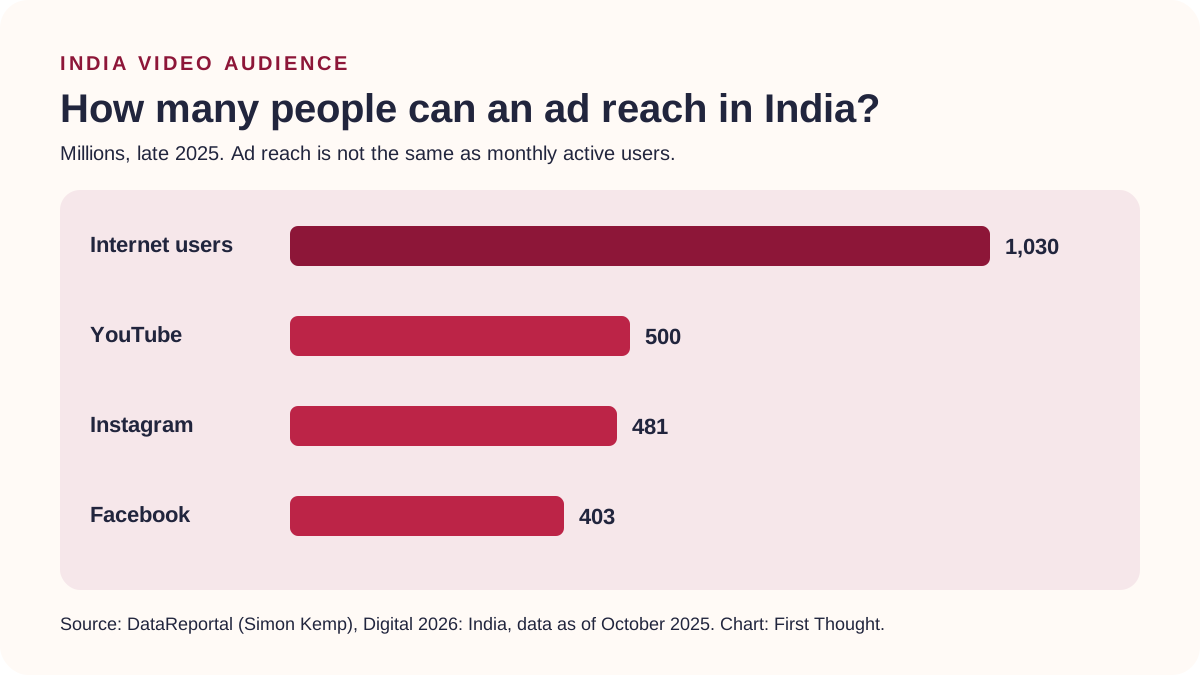
- India has a large video audience: DataReportal counts 500 million YouTube ad reach and 481 million Instagram ad reach in late 2025.
- Free tools exist inside the ad platforms, and Amazon Ads says its Video Generator creates up to six 15-second ads at no additional cost.
- ASCI's 2026 guidelines say an AI label does not make a misleading ad acceptable, and misleading synthetic depictions of product results or features are prohibited.
- The cheapest way to start is one product, three short videos with different hooks, one platform, and a two-week test before you scale.
What is an AI product video ad?
An AI product video ad is a 6 to 30 second advertisement in which software generates the motion, scenes, text and sometimes the voice, using your product photos or existing clips as the base. It sits between a plain static creative and a full studio shoot.
There are three common kinds. Image-to-video tools animate one or more product photos with camera moves, backgrounds and text. Template tools place your clips and photos into ready layouts with music and captions. Avatar tools put a synthetic presenter on screen to read a script. For a product seller, the first kind is usually the most useful, because the product itself stays the hero.
AI video does not replace knowing your customer. The tool can make movement, but it cannot decide which problem your product solves, which price point matters, or what doubt stops someone from buying. Those answers still come from you and your sales conversations.
Why are Indian brands moving to AI video ads now?
Indian brands are moving to AI video because video reach in India is large and the platforms now ship free AI tools inside their ad managers. Together, these two changes cut the time and money needed to test more than one creative.
The audience numbers are big. DataReportal's Digital 2026: India report (2025) counts 1.03 billion internet users and 500 million social media user identities in India as of October 2025. The same report lists ad reach of 500 million on YouTube, 481 million on Instagram and 403 million on Facebook, while noting that ad reach is not the same as monthly active users.
Video also sits inside the buying journey. Think with Google India (2025) cites a Google/Ipsos Shopper Moments study in which 87% of Indian consumers watch YouTube or YouTube Shorts during their shopping journey.
The platforms are pushing AI creative tools hard. Amazon Ads expanded its Video Generator (2025) to India and seven other countries on 11 November 2025. Meta told afaqs (2025) that nearly 2 million advertisers were using its Advantage+ creative generative AI tools.
What results have brands in India reported from AI video ads?
Large Indian brands have published results from AI video ads, but these are big-budget cases, not small-business benchmarks. They show what is possible when good product data meets steady testing, not what your shop will get.
Think with Google India (2025) reports three cases:
| Brand | What they did | Reported result |
|---|---|---|
| Zepto | Turned product photos into video ads with a Veo-based video generation solution | Doubled app install volumes while being 11% more efficient |
| Ajio | Made product carousel videos across a catalogue of 2.5 million styles, with Gemini text-to-speech voiceovers | 1.8X scale and 20% incremental conversions on YouTube Shorts and in-stream ads |
| Zee5 | Used a Gemini-powered editing tool for trailers | Trailer creation time fell from 16 hours to under an hour |
Read these results with care. They come from Google's own marketing site, the brands had large catalogues and budgets, and the numbers depend on their account history. For a small business, the useful lesson is simpler: AI made it cheap to produce many variations, and the brands that won kept testing them.
How much does an AI product video ad cost in India?
An AI product video ad in India can cost nothing beyond your ad spend if you use a free platform tool, or roughly ₹500 to ₹2,000 a month for a common subscription tool, according to vendor price lists. Agency work and studio shoots are priced per project, so ask for written quotes.
| Route | Typical cost | What you get | Watch out for |
|---|---|---|---|
| Free platform tools (Amazon Video Generator, Meta Advantage+ creative) | No extra tool fee; you pay for the ads you run | Amazon: up to six 15-second videos per run from a product image or video | Works only inside that platform; limited control over every frame |
| Subscription AI video tools | About ₹499 to ₹2,000 a month on the plans listed in a September 2026 vendor round-up (2026) | Templates, image-to-video, captions, resizing | Credit limits, watermarks on free tiers, annual billing; the round-up is written by a tool vendor, so check prices yourself |
| Freelancer or agency using AI | Quoted per video or per month | Script, editing, brand fit, platform versions | Ask what is AI-made, who owns the files and how many revisions are included |
| Traditional studio shoot | Quoted per project | Real footage, models, locations | Highest cost and slowest to change; still best for food texture, fabric drape and demos |
The Amazon figure is from Amazon Ads' launch note (2025), which says the tool is offered "at no additional cost" in Creative Studio. The subscription prices are from the Koro round-up (2026), which lists Canva Pro at ₹499 a month, InVideo AI at about ₹1,660 a month on annual billing and Predis.ai at about ₹2,000 a month on annual billing. Prices change often, so treat them as a starting point.
Hidden costs matter more than the tool fee. Count the time to write scripts, the person who checks every frame against the real product, the editor who fixes text and timing, and the ad budget you need to test. A free tool with no testing budget teaches you nothing.
Which AI tools should a small business in India start with?
Start with the free tool inside the platform where you already sell, then add one subscription tool only if you need more control. Picking five tools at once spreads your time thin and gives you no clear learning.
If you sell on Amazon
Amazon's Video Generator lives in Creative Studio in the Amazon Ads console. According to Amazon Ads (2025), you give it a product image or video and the ASIN, it also reads your product detail page and A+ content, and it returns up to six 15-second video ads. You can change headlines, fonts, colours and logo placement before you use them in Sponsored Brands video campaigns.
If you sell through Instagram and Facebook
Meta's Advantage+ creative options sit inside Ads Manager. Coverage in afaqs (2025) describes video generation with AI-made music among the tools. Features roll out in stages and differ by account, so check what your Ads Manager shows before planning around one.
If you need videos for many places
A subscription editor helps when you need the same product video in Reels, Shorts, WhatsApp Status and your website. Choose by three tests: does it keep your product's real colour and shape, can it export a clean 9:16 file without a watermark, and can you add Hinglish or regional text easily.
When to bring in a person
Bring in an editor or agency when the product needs a demonstration, when you sell in a regulated category such as health or finance, or when you want one brand look across 20 or more videos a month. Our guide on AI ad creative testing explains how to brief and test those variations.
How do you make an AI product video ad? A 7-step process
You make a good AI product video ad by starting from accurate product photos and one clear customer problem, then generating, editing, labelling and testing short versions. The steps below fit a small team with one marketer and one editor.
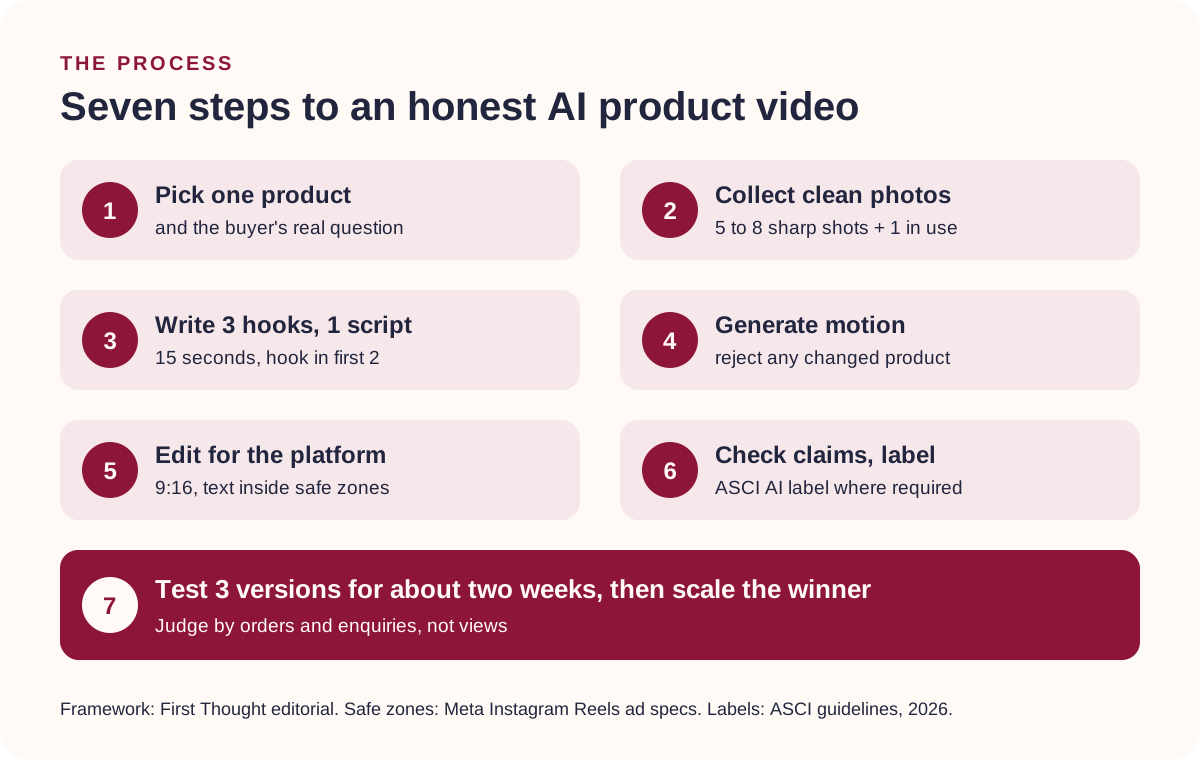
- Pick one product and one buyer question. Choose a product that already sells and write the question a buyer asks before paying, such as "Will this fit my kitchen?" or "Is the colour the same as the photo?"
- Shoot or collect clean product photos. Use 5 to 8 sharp photos on a plain background, plus one in-use photo. Our product photography brief template lists the angles to cover.
- Write three hooks and one script. Keep the script to 15 seconds: hook in the first two seconds, one benefit, one proof such as size or material, then the offer and call to action.
- Generate the motion. Use the platform tool or your editor to create 3 to 6 versions. Reject any version where the product's shape, colour, label or size has changed.
- Edit for the platform. Export 9:16 for Reels and Shorts. Meta's Instagram Reels ad specs (2026) advise leaving about 14% at the top, 35% at the bottom and 6% on each side free of text and logos. Keep on-screen text in English or Roman-script Hinglish so it stays readable.
- Check claims and label where needed. Compare every frame with the real product. Add an AI label when ASCI's rules call for one (see the next section) and keep a record of what was generated.
- Test, then scale. Run the three versions with the same budget and audience for about two weeks. Keep the one that brings real enquiries or sales, not just views, and make new variations of its hook.
What do ASCI's AI labelling rules mean for product videos?
ASCI's 2026 guidelines say that AI-generated content which could mislead a buyer must be labelled, and that some uses are not allowed even with a label. For a product seller, the key rule is that the video must not show results or features the product does not really have.
According to medianews4u's report on the guidelines (2026), published on 29 September 2026 and effective three months after publication, ASCI groups AI use into tiers:
- Prohibited, even with a label: fabricated endorsements or testimonials, "misleading synthetic representations of product results or features", non-existent locations shown as real, unauthorised use of copyrighted work, and deepfakes or likeness use without consent.
- Label required: synthetic influencers and ambassadors, a real person's likeness or voice recreated with consent, fabricated events or settings that affect understanding, and demonstrations of products that do not currently exist.
- No label needed: routine edits such as colour correction and lighting fixes, decorative elements, obvious fantasy effects, AI-written ad copy, and subtitles or translations.
Accepted labels include "Audio/Video created using AI" and "Audio/Video enhanced using AI". ASCI's Secretary General and CEO, Manisha Kapoor, said the guidelines clarify "where the mere use of an AI label may not make an otherwise misleading advertisement acceptable."
In practice, an AI background behind your real product photo is usually decorative. An AI scene showing a cream removing pigmentation, a fabric that looks richer than it is, or a fake customer review is not acceptable. Health, beauty and finance products need extra care, and this article is general guidance, not legal advice.
Example: a Bareilly zari seller makes its first AI product video
Example (hypothetical, not a client result). A small zari-embroidery seller in Bareilly, Uttar Pradesh, sells dupattas on Amazon and through Instagram. They have good product photos but no budget for a model shoot every week.
Here is a realistic first month. In week one, the owner picks the best-selling dupatta and writes down the question customers ask most on WhatsApp: "Is the zari work as shiny in real life?" In week two, they run Amazon's Video Generator on that listing and pick two of the versions, and an editor makes one more 9:16 version for Reels using the same photos plus a short phone clip of the fabric moving in daylight.
Before anything goes live, the owner checks every frame against the real dupatta. One generated version made the gold thread look brighter than it is, so it is rejected. The phone clip stays because it answers the buyer's real doubt. In weeks three and four, each version runs with the same small budget, and the team counts orders and WhatsApp enquiries, not just views.
The example shows the order of work: one product, one buyer question, honest visuals and a fair test. The result is unknown until the test runs.
Common mistakes to avoid
Most weak AI product video ads fail for planning reasons, not because the tool was bad. These are the mistakes we see most often.
- The product changes shape or colour. Generative tools sometimes "improve" a product. If the video does not match what arrives at the door, you invite returns and risk breaking ASCI's rule on misleading product depictions.
- No hook in the first two seconds. A pretty camera move is not a reason to stop scrolling. Open with the buyer's question, the price, or the product in use.
- Text in the platform's danger zones. Captions under the like and comment buttons get covered. Follow the safe-zone guidance in the platform's ad specs.
- Devanagari or tiny text on screen. For mixed audiences, Roman-script Hinglish or English text is easier to read at a glance; use regional voiceover if needed.
- One video for every platform. YouTube's help page (2024) says Shorts can now be up to three minutes, but only square or vertical videos count as Shorts. Make platform versions on purpose.
- Fake people and fake reviews. A synthetic "happy customer" is a fabricated testimonial. Use real reviews with permission, or none.
- Judging by views. Count enquiries, add-to-carts and orders. Our ad creative testing guide shows a simple scorecard.
Checklist: is your AI product video ready to run?
A video is ready to run when it is accurate, readable, labelled where needed and set up for a fair test. Use this checklist before you press publish.
- The product's colour, shape, size, label and packaging match the real item in every frame.
- The first two seconds show the product or the buyer's question.
- Price, offer and claims match your listing and can be proven.
- Text sits inside the platform's safe zones and is readable on a phone.
- An AI label is added where ASCI's rules require one.
- No synthetic testimonials, fake locations or people used without consent.
- Music and footage are licensed or made by the tool under its terms.
- Three versions are ready with one change each (usually the hook).
- You know which number decides the winner: orders, enquiries or cost per lead.
Frequently asked questions
Are AI product video ads allowed in India?
Yes. AI product video ads are allowed in India, but they must follow the ASCI Code. ASCI's 2026 guidelines require labels such as "Video created using AI" where AI content could mislead, and prohibit fabricated testimonials and misleading synthetic depictions of product results or features, even when a label is used.
How much does an AI product video ad cost in India?
It can cost nothing beyond ad spend with free platform tools such as Amazon's Video Generator. Subscription tools listed in a 2026 vendor round-up range from about ₹499 to ₹2,000 a month. Agencies and studios quote per project, and you should also budget time for scripting, checking and testing.
Is Amazon's AI Video Generator free in India?
Yes. Amazon Ads says its Video Generator, available in India since 11 November 2025, is offered at no additional cost in Creative Studio. It creates up to six 15-second videos from a product image or video for Sponsored Brands video campaigns. You still pay for the ads you run.
Can AI video replace a product photoshoot?
Not fully. AI video works best when it starts from accurate product photos, so you still need clean, true-to-life images. For products where texture, fit or taste matters, such as fabric, furniture or food, real footage often answers buyer doubts better than generated scenes.
Do I need to label every AI-made ad?
No. Under ASCI's 2026 guidelines, routine edits like colour correction, decorative elements, obvious fantasy effects, AI-written copy and subtitles need no label. Labels are needed when synthetic content could change a buyer's understanding, such as synthetic influencers or demonstrations of products that do not exist yet.
What length should an AI product video ad be?
For most small brands, 6 to 15 seconds is a practical start, with the product or buyer question in the first two seconds. Amazon's tool makes 15-second videos. Instagram Reels ads accept up to 15 minutes and YouTube Shorts up to three minutes, but short versions are easier to test.
Which platform should I test AI product videos on first?
Test where you already sell. If most sales happen on Amazon, start with its free Video Generator. If enquiries come from Instagram or WhatsApp, start with 9:16 Reels. Running one platform first gives a clean comparison before you spend on more channels.
A practical next step
First Thought, a digital marketing and creative agency in Bareilly, Uttar Pradesh, makes short product videos, reels and ad creatives for small brands, using AI where it saves time and real footage where the product needs it. We start from your actual product photos and your customers' real questions, check every frame against the product, and set up a simple test so you can see which version brings enquiries. See our content production services or contact us for a free review of your current product videos. We will tell you honestly if a free platform tool is enough for your stage.
Sources & further reading
DataReportal: Digital 2026: India ↗Think with Google India: Drive growth with AI video ad creatives ↗Amazon Ads: Video generator for Sponsored Brands video campaigns ↗afaqs: Meta expands AI tools to help brands boost ad performance ↗medianews4u: ASCI issues guidelines for labelling AI-generated content in advertising ↗Meta Ads Guide: Instagram Reels ads specs ↗YouTube Help: Understand three-minute YouTube Shorts ↗Koro: Cheap AI Ad Generator for Small D2C Brands (vendor price round-up) ↗Practical frameworks are First Thought editorial recommendations. Hypothetical examples are not client results.