
The short answer
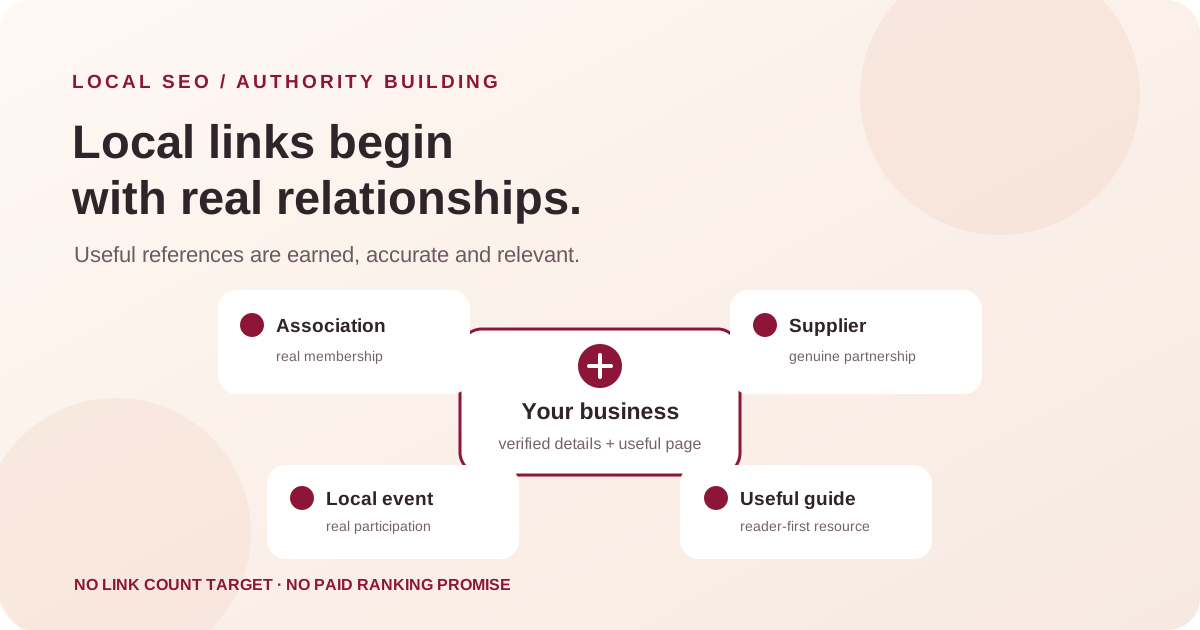
Local backlinks are links from other websites to a business website. A local citation is a mention of business details such as its name, address, phone number, or website; it may or may not include a clickable link. For a small business, the useful starting point is accurate information in genuinely relevant places, followed by links earned through real local relationships, useful resources, or newsworthy work. A large link count is not a goal by itself. Google says local results consider relevance, distance and prominence, and notes that prominence can reflect links and reviews. It also identifies paid links for ranking, automated link programs, excessive exchanges and low-quality directories as link spam. No tactic guarantees a ranking.
Local backlinks and local citations are different
People often use “citation” and “backlink” as if they mean the same thing. They overlap, but they describe different things. A link is a clickable path to a destination; a citation is a reference to a business or its details. A business directory can show the name and phone without linking to the website, link to a website while omitting the street address, or include both.
| Item | What it contains | Why a business might maintain it | What to check |
| :-- | :-- | :-- | :-- |
| Local citation | Business name and details; may not link to a site | Help a customer identify or contact the business | Correctness, eligibility, duplicate records and update process |
| Backlink | A clickable link from another site to a page | Help a reader reach a useful destination; a publisher may cite a source | Relevance, context, editorial independence and destination quality |
| Paid placement | A sponsored listing, advertorial or ad with a link | Reach an audience through advertising | Label the relationship and qualify the link where required |
| Internal link | A link between pages on your own website | Help visitors and crawlers move through related information | Clear anchor text and a useful destination |
A business can have accurate citations without earning many editorial links. It can also receive a relevant link from an association or local news article that does not function like a directory citation. Treat each opportunity according to what it does for the customer, not just whether a SEO tool labels it a “backlink.”
What Google says about local prominence and links
Google describes local results through three main factors: relevance, distance and prominence. Relevance is how well the business profile matches a search. Distance is how far the business is from the person or place in the query. Prominence describes how well-known the business is; Google says information such as how many websites link to a business and how many reviews it has can be part of that picture. The guidance does not provide a formula, a preferred link count, or a way to buy a better local position.
That distinction matters. A relevant mention can help a person discover a business and can contribute to the wider information available about it. It does not cancel out distance, poor service fit, inaccurate business details, or a weak customer experience. A link from an unrelated site with a convenient anchor phrase is not a substitute for being the right business for a nearby customer.
Google also says there is no way to request or pay Google for a better local ranking. Anyone selling a fixed number of links with a guaranteed local position is making a promise outside what Google says businesses can control. Ask for the actual work, the publisher, the destination page, the relationship behind the placement, and how paid links will be disclosed and qualified.
Start with a trustworthy business footprint
Before looking for new links, make the information a publisher or directory might use easy to verify. Write down the exact public business name, website, phone number, address or service-area setup, current contact route, and the services the business actually offers. Use owner-confirmed details. If the firm serves customers at a physical location, do not describe it as a service-area-only business; if it does not receive customers at a public address, do not present a home or virtual office as a storefront.
Review the business website and the profiles it controls. Confirm that pages load, the preferred domain resolves, contact links work, and service descriptions are consistent. If a third-party listing contains an old phone number or address, correct the source where possible. Do not create several profiles or directory records for variations of the same business merely to increase the number of mentions.
A consistent footprint makes it easier for a customer to confirm that two references point to the same real company. It also gives a journalist, partner, association or directory editor a reliable source when checking a name or link. This is a hygiene step, not a claim that every citation directly changes rankings.
Nine realistic ways to earn relevant local links
A useful local link usually has a reason to exist apart from passing ranking signals. The following ideas work only when they reflect a real relationship or useful resource; they are options to assess, not a guaranteed link-building formula.
1. Join a real chamber or trade association
If the business is an eligible member of a chamber of commerce, professional association, trade body or recognized local network, check whether its member directory includes an accurate public profile. Membership should be real and worthwhile without the link. Follow the organization’s rules for the company name, category, address and website. Do not pay for a membership solely because somebody promised a “dofollow” backlink.
2. Ask genuine suppliers or partners to correct a useful reference
A supplier may publish a dealer, stockist or partner directory. A venue may list the businesses involved in an event. A professional partner may maintain a resource page for clients. If the relationship exists and the listing would help a customer, ask the site owner whether the existing information should include the current website. Do not demand an exact keyword-rich anchor or require a reciprocal link.
3. Make a useful resource that a local audience can cite
A checklist, public guide, practical calculator, accessible map, or original explanation can earn attention when it solves a real problem. Start with a question customers repeatedly ask or a process the company can explain accurately. Give the resource a stable URL, describe its scope, name its source and update date, and make it usable on a phone. Do not create a thin PDF, keyword list or AI-generated page solely to ask other sites for links.
4. Share verified local data with local publishers
A business can sometimes offer original, privacy-safe information that helps a local newsroom, association or researcher explain a topic. First confirm the data’s source, collection period, definition, sample limits and permission to publish it. Remove personal or confidential information. If the business has no defensible data, use a practical expert explanation instead of inventing a survey or claiming to represent the whole city.
5. Support an event or community activity that fits the business
A real event sponsor may be listed on an organizer’s page, event program or recap. Choose an activity that makes sense for the business and the audience. Confirm what the sponsorship includes, whether a link is part of the package, how the arrangement will be disclosed, and what the event site will publish. Treat sponsorship as audience access and community support; a link is an incidental benefit, not the reason to fabricate an event.
6. Offer expert context to a relevant local story
A journalist, campus publication, trade newsletter or local organization may need a knowledgeable source. Be specific about what the business can accurately explain, answer questions promptly, and provide sources for factual claims. An editor decides whether to include a mention or link. Do not send mass press releases with optimized anchor text and expect editorial links in return.
7. Provide a genuinely useful workshop or educational contribution
If a team member can teach a practical topic, a library, college, business network or community group may publish a speaker page or recap. Offer useful content regardless of whether the page links back. Check that the event actually happens, that the business is represented honestly, and that any recording or materials have permission to be shared.
8. Fix inaccurate or duplicate directory listings
A small number of accurate, relevant directories can help customers find the right contact details. Start with the profiles customers and business partners actually use, plus reputable local or sector-specific directories with clear editorial or verification standards. Remove duplicates where the platform allows it. Skip directories with unrelated categories, scraped data, hidden fees, spam pages, or a promise to submit the site to hundreds of networks.
9. Turn useful relationships into editorial references, without requiring a link
Customers, collaborators, suppliers and community organizations sometimes publish a story about work they did together. Ask for factual accuracy and permission before quoting or naming anyone. A reference is valuable even when the publisher chooses not to link. Do not offer a reward for a followed link, require a customer to mention a phrase, or write a supposedly independent recommendation under another person’s name.
How to assess an opportunity before you spend time or money
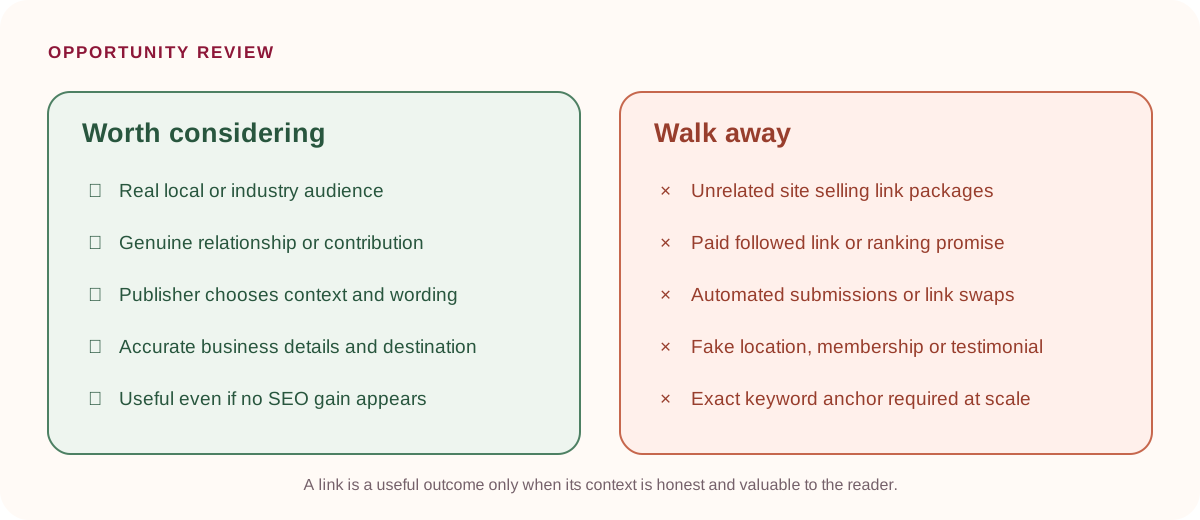
Use a short review before accepting an offer. The purpose is to protect customers and the business, and to identify work that has value even if no ranking benefit appears.
| Check | Strong signal | Warning signal |
| :-- | :-- | :-- |
| Audience fit | A real local or industry audience could use the page | The site covers unrelated topics and exists mainly to sell placements |
| Relationship | Membership, sponsorship, contribution or source role is genuine | The publisher cannot explain why the business belongs there |
| Editorial control | The publisher checks information and can choose whether to link | Payment requires an unmarked editorial link or exact anchor text |
| Page quality | The page has a clear purpose, accessible information and real readers | The page is a long list of unrelated outbound links or copied descriptions |
| Business accuracy | Name, location, service and destination are verified | The pitch asks you to add keywords to the business name or invent a location |
| Cost | The fee buys a transparent event, ad or membership with customer value | The price is framed as a guaranteed ranking link or number of dofollow links |
| Ongoing care | There is a way to correct or remove outdated details | Nobody accepts responsibility for stale listings or pages |
A link can still be useful when it is marked nofollow or sponsored; the reader may follow it and the business may gain qualified referral visits. Google’s rules say paid links should be qualified so they do not pass ranking credit. The business should judge a paid placement as advertising or sponsorship, not disguise it as editorial endorsement.
A simple four-week local link-building plan
This sample plan is a workflow, not a performance benchmark. It assumes a small team with limited time and can be stretched or shortened to suit the business.
Week 1 — Clean the source of truth. Confirm business name, address or service-area details, phone, website and service descriptions with the owner. List the directories and partner pages the company already controls. Record duplicates or details that need correction. Do not create new profiles just to fill a spreadsheet.
Week 2 — Choose a resource or relationship. Pick one useful asset or real partner opportunity. For a resource, define the reader’s problem, source facts, owner, format and review date. For a relationship, write down why the audience benefits and what the partner actually agreed to do. Mark assumptions as assumptions.
Week 3 — Make a small number of relevant requests. Contact only the relevant site owners through a public business route. Explain the factual change or resource and why it might help their audience. Do not send identical mass pitches, threaten to remove a link, ask for a specific followed link, or promise that the placement will improve rankings.
Week 4 — Check what happened. Verify the destination page and link manually. Record whether the page is live, the type of placement, the relationship, the publication date and any referral visits that can be measured. If a request was declined, note it and move on. Do not count an unconfirmed submission as a link acquired.
Track opportunities with a simple record
A small spreadsheet is enough. For each opportunity, record the publisher or directory, URL, audience, relationship type, contact route, page or resource that may help, whether payment or sponsorship is involved, link qualification if relevant, status, date checked and next action. Add a note if the details depend on an owner confirmation.
A tracker helps distinguish three different outcomes: a corrected business citation, an editorial mention or backlink, and a referral visit. They are not interchangeable. A page that lists a business is not proof of a lead; a link that exists is not proof of a ranking gain.
Use the local link opportunity tracker (CSV) to record one candidate at a time. It is a blank planning template, not benchmark data.
Measure useful outcomes without pretending a link caused them
For each new reference, record the source and the date it was first verified. Check that the link reaches the intended page, the page loads without an error, and the business information is accurate. If the placement is paid or sponsored, make sure it is disclosed and appropriately qualified.
Google Search Console’s links report can show links Google has discovered, but it is not a complete record of every page on the web, and updates may take time. Use it as one source of observation, not a live counter of every outreach result. For referral activity, use an analytics report if the business has consent-appropriate analytics connected. A tagged campaign URL can help distinguish traffic from an event or partner placement, but do not put a person’s name, email, phone number or other personal information into a URL.
Track the business outcome that matters: relevant enquiries, calls, bookings or visits where the source can be recorded reliably. Keep the period and data limitations beside the number. If a visitor saw a directory, then later searched the brand or called from another device, attribution may be incomplete. Do not attribute a sales change to one link based on timing alone.
Search Console impressions, clicks and average position describe Google Search performance for the property and report filters selected. They do not tell you whether ChatGPT, Gemini, Claude or Perplexity cited a page. A platform-specific citation observation should be recorded separately with the exact query, product, date, geography and result state. No citation or ranking change should be promised from a link-building plan.
Practices to avoid
Google defines link spam as creating links primarily to manipulate search rankings. Its examples include buying or selling links for ranking, automated link programs, excessive exchanges, low-quality directories, distributed widgets and forum comments with optimized links. A large “50 backlinks” package can therefore create risk without establishing that any page helps a customer.
Avoid these shortcuts:
- Buying a batch of dofollow links or paying an article site to pass ranking credit.
- Submitting the website to hundreds of general directories or Web 2.0 pages.
- Trading links repeatedly with unrelated businesses or building pages whose only purpose is cross-linking.
- Repeating an exact commercial phrase as anchor text across many pages.
- Posting self-promotional comments in forums, Q&A sites or social communities.
- Creating fake branches, fake memberships, invented awards or customer stories.
- Asking a customer or partner to publish a review or link in exchange for a reward.
For legitimate advertising and sponsorship, disclose the relationship and qualify links in line with current search-engine guidance. For a paid relationship where the publisher controls its own site, ask how it labels the placement. If the seller will not explain where links will appear, whether the content is disclosed, and how the site handles paid links, decline the package.
What local link building can and cannot do for AI search
A real, accurate mention on a relevant organization or publication can make it easier for people to verify who a business is and what it does. Google’s local guidance explicitly mentions links as one kind of information that may contribute to prominence. That supports maintaining relevant relationships and useful references as part of a wider local presence.
It does not prove that a link will cause ChatGPT, Gemini, Claude, Perplexity or another answer tool to recommend the business. These products retrieve and present information differently, and a citation can depend on the question, location, mode and time. Keep the site’s own service pages clear and factual, make the business identity consistent, and earn external references for reasons a human reader would recognize. Measure AI references directly where the platform or tool provides evidence; do not infer them from backlink counts.
For this reason, an ethical local backlink plan is one part of search and business development. It complements accurate profiles, useful service pages, a working enquiry path, real customer feedback and consistent reporting. It cannot replace those pieces.
Frequently asked questions
How many local backlinks does a small business need?
There is no universal number. Google does not publish a target link count for improving local ranking. Begin with accurate citations and a short list of relevant organizations or resources. Review each opportunity for audience fit, truthfulness, editorial independence and customer usefulness rather than trying to reach a quota.
Are local citations the same as backlinks?
No. A citation is a reference to business details; a backlink is a clickable link from another website. A directory may provide both, one, or neither. Keep listings accurate because people use them to find and contact businesses, and evaluate the link separately.
Do directory links help local SEO?
Some directories can help customers find accurate business information, particularly when the directory is reputable and relevant to the industry or area. A directory link does not automatically improve rankings. Avoid low-quality directories, automated submissions and pages created only to sell ranking links.
Should I buy local backlinks?
Do not buy links in order to manipulate rankings. Google classifies buying links for ranking purposes as link spam. A paid advertisement or sponsorship can be legitimate when it is transparent and its links are qualified appropriately. Evaluate it as audience reach, not as a guaranteed ranking package.
Do local backlinks help AI search citations?
There is no verified rule that a certain number or type of backlinks guarantees citations from AI tools. Relevant external references can help people verify a business, and Google documents links as one source of prominence information for local results. Measure each AI search product separately before making a citation claim.
How long should I wait to judge a new link?
There is no reliable fixed timeline for a ranking effect. First verify that the link is live and the destination works. Then compare Search Console or analytics observations over a defined period, accounting for other changes and seasonality. Do not claim a link caused a change solely because the numbers moved afterward.
What anchor text should a partner use?
Use natural wording that describes the destination or the relationship. The publisher should choose wording that reads clearly to its audience. Do not demand the same exact-match commercial phrase across links; Google warns against keyword-rich link patterns used to manipulate ranking signals.
A practical next step
Start with one page of verified business details and ten possible local or industry references. Score each by customer relevance, real relationship, accuracy and transparency; mark unclear facts as pending. Correct the few listings that matter to customers, then pursue one genuine partnership or resource at a time. For help reviewing a website’s local search foundations, see First Thought’s SEO and AEO service or contact the team with your business type and service area.
Sources and further reading
- Google Business Profile: Tips to improve your local ranking on Google
- Google Search Central: Spam policies for Google web search
- Google Search Central: Link best practices
- Google Search Central: SEO Starter Guide
- Google Search Console Help: Links report
- Google Analytics Help: URL builders and campaign parameters
Search-volume figures, rankings, backlink counts, client outcomes and AI citation results were not available for this article and are not claimed. The local link opportunity examples are practical editorial suggestions; verify eligibility, business details, costs and publisher rules before acting.
Sources & further reading
Google Business Profile: Tips to improve your local ranking on Google ↗Google Search Central: Spam policies for Google web search ↗Google Search Central: Link best practices ↗Google Search Central: SEO Starter Guide ↗Google Search Console Help: Links report ↗Google Analytics Help: URL builders and campaign parameters ↗Practical frameworks are First Thought editorial recommendations. Hypothetical examples are not client results.