The short answer
An AI agent is one piece of software that takes a goal, picks its own tools and steps, and finishes a defined job, such as answering a WhatsApp enquiry. Agentic AI is the wider idea of systems that plan, act and adapt toward a goal, often with several agents working together under one coordinator.
Most writers use the two terms loosely, and some use them for the same thing. For a business owner the practical question is simpler: how much freedom are you giving the software, and who checks its work?
Key takeaways
- An AI agent is a single system in which a language model chooses its own next step and its own tools to finish one defined job, while agentic AI is the broader approach of planning and acting toward a goal, often through several agents and a coordinator.
- The terms are not defined the same way everywhere: Vercel uses "agentic AI" for one agent or many, while an arXiv taxonomy reserves it for multi-agent systems, so ask a vendor what they mean.
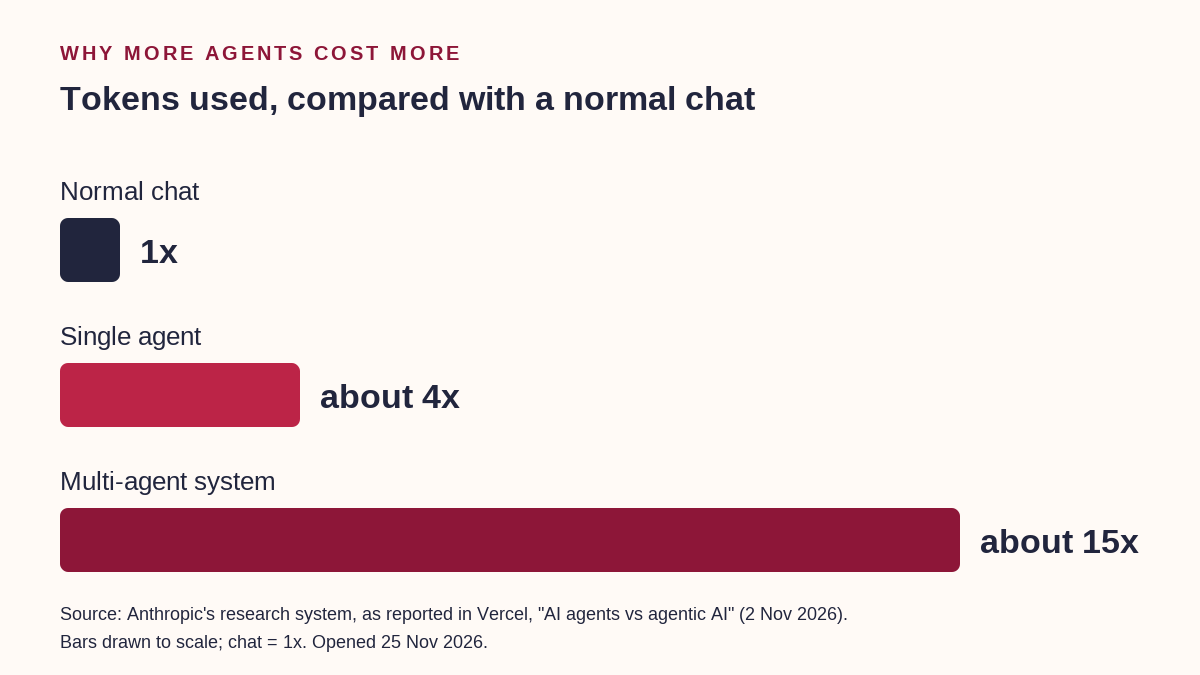
- More freedom costs more: Anthropic warns of higher costs and compounding errors, and multi-agent runs used about 15 times the tokens of a chat in its own research system.
- In India, interest is far ahead of results: Deloitte found over 80% of Indian organisations exploring autonomous agents, but only 29% could fully scale up to 30% of their proofs of concept.
- A small business should start with a fixed workflow or one narrow agent, keep a person approving risky steps, and add agentic coordination only after that first job runs well for a month.
What is an AI agent?
An AI agent is a program that uses a language model to decide which steps and tools to use to reach a goal you give it. Anthropic, in its widely read guide "Building effective agents" (19 December 2024), defines agents as systems where "LLMs dynamically direct their own processes and tool usage, maintaining control over how they accomplish tasks".
Three parts make an agent. A model does the reasoning, tools let it act (your CRM, calendar, WhatsApp, a spreadsheet), and a loop lets it look at the result and decide what to do next. If you want the full walk-through, our guide on what AI agents are and how they work covers the five parts in detail.
A simple example: a buyer writes on WhatsApp, "Do you have a two-bedroom flat near Civil Lines, and can I visit on Saturday?" An agent checks your listings and diary, proposes two slots and writes the reply. If the budget is missing or the buyer sounds angry, it hands the chat to a person.
Researchers describe the same idea in a similar way. A May 2025 paper on arXiv by Ranjan Sapkota, Konstantinos Roumeliotis and Manoj Karkee calls AI agents "autonomous software entities engineered for goal-directed task execution within bounded digital environments". The words that matter are "bounded" and "task". An agent lives inside a fence.
What is agentic AI?
Agentic AI is a way of building AI systems that plan, make decisions and carry out multi-step work toward a goal with limited human steering. IBM puts it this way: "Agentic AI focuses on achieving goals by planning, making decisions and carrying out multi-step workflows", and contrasts it with generative AI, which "creates new content such as text, images, video, audio and software code".
In day-to-day business terms, think of the difference between a person and a department. An agent is a capable person with one clear job. Agentic AI is closer to a small department: one part qualifies leads, another follows up, another reports to you, and something at the top decides who does what and when.
That "something at the top" is called an orchestrator. In the pattern Vercel calls orchestrator-worker, a lead agent plans the work, starts sub-agents and combines their results.
What are the differences between an AI agent and agentic AI?
The main differences are scope, planning horizon, number of moving parts and how much a person must supervise. An agent handles a defined job. Agentic AI pursues a broader goal and works out the jobs itself. The table below uses the definitions from the sources in this article, not a universal standard.
| Question | AI agent | Agentic AI |
|---|---|---|
| What is it? | One system that finishes a defined task | A goal-driven approach, often with several agents |
| Typical scope | One job: reply to enquiries, book a visit, draft a report | A larger outcome: run follow-up for a whole campaign |
| Who splits the work into steps? | The agent, inside a fenced task | The system, often through an orchestrator |
| Number of parts | Usually one agent plus a few tools | Often several agents, shared memory and a coordinator |
| Planning horizon | Short: the steps of one job | Longer: several tasks in a sequence, revised on the way |
| Human supervision | Easy: one clear job to read | Harder: more steps and more handoffs to audit |
| Running cost | Lower | Higher, because more model calls are needed |
| Typical risk | A wrong answer on one job | A wrong answer that passes from agent to agent |
| Best first use | Repeated, rule-based jobs | Open-ended goals that need many kinds of work |
Real products blur these lines. The arXiv taxonomy calls agents "single-step" and "reactive" and agentic AI "multi-step" and "proactive", yet many single agents already plan several steps.
Why do websites give different answers?
Websites differ because there is no agreed standard, and the words are used both as a pair and as a ladder. Vercel's explainer (2 November 2026) says outright that "agentic AI" is a broader term for systems that plan, act and adapt toward a goal with one agent or several, and notes that a narrower academic usage keeps it for coordinating multi-agent systems.
Here are the three common readings:
- A property. A system is "agentic" if it acts with some autonomy, so a single agent is agentic too.
- A system of agents. The arXiv paper describes agentic AI as multiple specialised agents that coordinate, communicate and divide sub-tasks.
- The next level. Many vendor pages treat it as a smarter upgrade. Kore.ai, for example, frames the move as going "from following directions to owning outcomes", with little evidence that the upgrade works better for a given task.
When you buy, ask an agency three questions: how many agents, which tools can they touch, and who reads the output before it reaches a customer. The answers tell you more than the label does.
Are workflows, agents and multi-agent systems the same thing?
No. A workflow follows steps that a developer wrote in advance, an agent chooses its own steps, and a multi-agent system has several agents working under coordination. Anthropic draws the first line clearly: "Workflows are systems where LLMs and tools are orchestrated through predefined code paths", while agents direct their own process.
Seeing the three side by side helps:
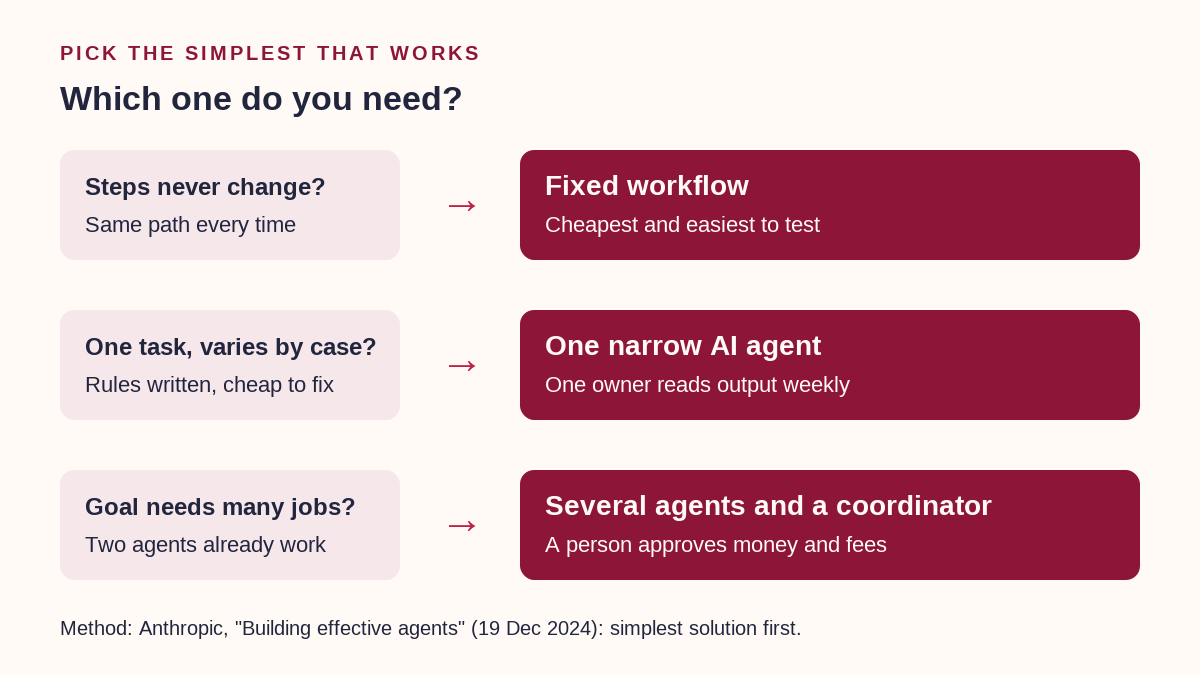
- Workflow. "When a new enquiry arrives, ask the model to classify it, then send the matching template." The path is fixed. The model fills in a step, but the order never changes. It is cheap, predictable and easy to test.
- Single agent. "Handle this enquiry." The model decides whether to check stock, look at the diary, ask a question or hand over. Flexible, but you must test more cases.
- Multi-agent system. "Grow bookings for the January batch." A coordinator hands parts of the goal to an enquiry agent, a follow-up agent and a reporting agent, and merges what comes back.
Anthropic's advice sits in the middle of this ladder: find "the simplest solution possible, and only increasing complexity when needed". Climb one step at a time, and only when the step below works.
Does more autonomy mean better results?
Not always, and often it means higher cost and more ways to go wrong. Anthropic states that "agentic systems often trade latency and cost for better task performance" and that the autonomous nature of agents means higher costs and the potential for compounding errors.
Vercel's explainer gathers numbers that show the trade. It reports that in Anthropic's research system, multi-agent runs used about 15 times the tokens of a chat, while single-agent runs used about 4 times. Tokens are the units a model charges for, so more tokens usually means a bigger bill and a slower answer.
The same page cites a benchmark called PlanCraft in which all four multi-agent designs scored 39% to 70% below the single-agent baseline. It also cites a 2026 paper (arXiv 2604.02460) finding that, with equal reasoning budgets, single agents matched or beat multi-agent systems on multi-hop reasoning. Multi-agent designs did help elsewhere, for example up to 80.8% higher on financial reasoning for a centralised design, so the right shape depends on the task.
These figures come from vendor and lab tests, not independent field studies of small businesses. Treat them as a warning about the pattern, not a forecast for your shop.
How much of this is real in India today?
Interest is high, but real, scaled use is rare. Two Indian surveys and one global forecast give the clearest picture, and each is from a different year, so read them as separate snapshots, not one trend line.
| Finding | Number | Source and year |
|---|---|---|
| Indian organisations exploring autonomous agents | Over 80% | Deloitte India, State of GenAI (press release 2 April 2025; fieldwork July–September 2024; 200 respondents) |
| Leaders already deploying agentic AI | 24% | EY India, "The AIdea of India: Outlook 2026" (16 November 2025; EY India C-suite GenAI survey, 200 enterprises) |
| Organisations that could fully scale up to 30% of their AI proofs of concept | 29% | Deloitte India, 2025 (same survey) |
| Agentic AI projects Gartner expects to be cancelled by end of 2027 | More than 40% | Gartner, reported by Reuters (25 June 2025) |
| Vendors Gartner calls genuine out of thousands claiming agentic AI | About 130 | Gartner, reported by Reuters (25 June 2025) |
The Deloitte release also lists what holds companies back: errors with real-world consequences worry 36% of respondents, and bias and hallucinations 30%. Anushree Verma, a Gartner senior director analyst, told Reuters that "most agentic AI projects right now are early stage experiments or proofs of concept".
What this means for a business with a team of 5 to 50: nobody is far ahead of you. You do not need a multi-agent platform this quarter. You need one repeated job done well.
What is "agent washing", and how do you spot it?
Agent washing is when a vendor relabels an old chatbot, script or assistant as an "AI agent" or "agentic AI" without adding real autonomy. Gartner, as reported by Reuters, estimates that only about 130 of the thousands of vendors claiming agentic AI actually deliver it.
Use this four-question test on any demo or quote:
- Does it choose its own steps? Ask for a case where it took a different path on a different input. If every run follows one script, it is a workflow: fine, but price it like one.
- Which tools can it use? A real agent acts in your CRM, calendar or WhatsApp. If it only writes text for a person to copy, it is an assistant.
- What happens when it is wrong? Look for a handover to a person, a step limit and a log of every action.
- Can you test it on your own data? Ask to see it run on last month's real enquiries before you pay.
Which one does a small Indian business need first?
Start with a fixed workflow or one narrow agent, and add agentic coordination only when two or more such jobs already work and need to be connected. A narrow agent suits a job that repeats, has written rules and is cheap to fix when it slips.
Follow these steps:
- List your repeated jobs. Write down tasks that happen at least 20 times a week, such as enquiry replies, quote follow-ups, appointment reminders and review requests. This 20-a-week figure is our own rule of thumb, not an industry standard.
- Pick the one with the clearest rules. If you can explain the right answer in five lines, a workflow or narrow agent can do it. If you cannot, write the rules first.
- Decide what the software may and may not do. For example: it may reply, book and remind; it may never quote a discount, promise a result or change a price.
- Keep one named person in charge. That person reads a sample of the output every week and fixes the rules.
- Run it on past messages first. Test on 50 to 100 real old enquiries before any live customer sees it.
- Run it live for four weeks. Check how many chats it finished, how many it handed over and how many a person had to correct.
- Connect a second job only after that. Now you have two agents, and a coordinator can start to make sense.
Example (illustrative, not a client result): a coaching centre in Bareilly gets admission enquiries on WhatsApp, Instagram and phone. In month one, a single agent answers on WhatsApp only: it shares batch timings and fees from a fixed document, asks the student's class and subject, and books a counselling call. A counsellor reads every handed-over chat. By month three, with that job stable, a second agent reminds parents before the call. Only then does a coordinator that says "fill the January batch" make sense, and a person still approves any message about fees.
If WhatsApp is your first channel, our step-by-step guide on how to automate WhatsApp Business messages with AI covers the rules, templates and testing.
How much does each one cost to run?
An agent costs more to run than a fixed workflow, and a multi-agent system costs more again, because every extra step is another paid call to a model. Exact rupee figures depend on your volume, model and messaging fees, so we do not quote a range here. In Anthropic's research system, as reported by Vercel, a single agent used about 4 times the tokens of a chat and a multi-agent run about 15 times.
For build and running costs in rupees, including GST and WhatsApp fees, see our guide to AI agent development cost in India. When you compare quotes, ask for the cost per finished task, not only the monthly platform fee.
What are the risks of letting software act on its own?
The main risks are confident wrong actions, errors that pass from one agent to the next, privacy exposure and nobody owning the output. Limit each agent's tools, set a step limit, keep a readable log, require human approval for money, discounts and refunds, and tell people when they are talking to software.
Common mistakes to avoid
- Buying the label. "Agentic" on a sales deck is not evidence. Ask for a demo on your own data.
- Starting with five agents. One agent that works beats five that nobody tests.
- No owner. If nobody reads the output weekly, small errors become habits.
- Skipping the written rules. If you cannot say what a good answer looks like, a model cannot guess it for you.
- Giving it money-moving power on day one. Let it reply and book first. Discounts and refunds stay with a person.
- Judging by one demo. Test on messy, real, Hinglish messages with spelling mistakes.
- Counting only the platform fee. Add model usage, messaging fees, GST and the reviewer's time.
A practical next step
First Thought, a digital marketing and creative agency in Bareilly, Uttar Pradesh, builds AI agents and automations for businesses across India, and runs parts of its own office on them. We start with one job you repeat every week, show you what the agent would do on your own sample messages, and keep a person's approval in the loop. We do not promise a saving before we have seen your volume and your data. If you want a second opinion on a plan or a vendor quote, message us on WhatsApp or use the contact page. See our AI agents service or contact First Thought.
Frequently asked questions
What is the difference between an AI agent and agentic AI in one line?
An AI agent is one system that takes a goal and finishes a defined job by choosing its own tools and steps. Agentic AI is the broader approach of planning and acting toward a goal, often with several agents and a coordinator. Some writers use the two terms for the same thing.
Is agentic AI better than an AI agent?
Not by default. Agentic systems can handle broader, open-ended goals, but Anthropic notes they trade latency and cost for performance and carry a risk of compounding errors. For a defined, repeated job, a single agent or a fixed workflow is usually cheaper, faster and easier to check.
Is ChatGPT an AI agent or agentic AI?
A plain chat window is neither, because it answers and does not act in your other software. When the same model is connected to tools, memory and a goal, and is allowed to take actions, it becomes the core of an agent. Several such agents under a coordinator would be agentic AI.
Is agentic AI the same as generative AI?
No. IBM describes generative AI as creating new content such as text, images, audio and code, while agentic AI focuses on achieving goals through planning, decisions and multi-step workflows. Agentic systems usually use generative models inside them, so the two often work together.
Are Indian businesses using agentic AI yet?
Some are, mostly at larger firms. EY India reports 24% of leaders in its survey of 200 enterprises are already deploying agentic AI, and Deloitte India found over 80% exploring autonomous agents, though only 29% could fully scale up to 30% of their proofs of concept.
What is agent washing?
Agent washing is when a vendor relabels a chatbot, script or assistant as an AI agent without real autonomy. Gartner estimates that only about 130 of the thousands of vendors claiming agentic AI are genuine. Test any claim by asking the vendor to demonstrate the system choosing a different path on your own data.
How should a small business start with AI agents?
Pick one repeated, rule-based job that happens at least 20 times a week, write its rules, test it on 50 to 100 past messages and run it live for four weeks with one person reviewing. Add a second agent or a coordinator only after the first job works reliably.
Sources and further reading
- Anthropic, "Building effective agents" (19 December 2024) — https://www.anthropic.com/engineering/building-effective-agents
- Sapkota, Roumeliotis and Karkee, "AI Agents vs. Agentic AI: A Conceptual Taxonomy, Applications and Challenges", arXiv:2505.10468 (15 May 2025) — https://arxiv.org/html/2505.10468v1
- Vercel, "AI agents vs agentic AI: Key differences" (2 November 2026) — https://vercel.com/i/ai-agents-vs-agentic-ai
- IBM, "Agentic AI vs. generative AI" (2026) — https://www.ibm.com/think/topics/agentic-ai-vs-generative-ai
- Reuters via The Star, "Over 40% of agentic AI projects will be scrapped by 2027, Gartner says" (25 June 2025) — https://www.thestar.com.my/tech/tech-news/2025/06/25/over-40-of-agentic-ai-projects-will-be-scrapped-by-2027-gartner-says
- EY India, "Is India ready for Agentic AI? The AIdea of India: Outlook 2026" (16 November 2025) — https://www.ey.com/en_in/insights/ai/agentic-ai-india
- Deloitte India, "India rides the Agentic AI wave as more than 80 percent of businesses explore its potential" (2 April 2025) — https://www.deloitte.com/in/en/about/press-room/india-rides-the-agentic-ai-wave.html
- Kore.ai, "Agentic AI vs AI agents: Key differences enterprises need to know" (2026) — https://www.kore.ai/blog/agentic-ai-vs-ai-agents
Sources and further reading
Anthropic, "Building effective agents" (19 December 2024) ↗Sapkota, Roumeliotis and Karkee, "AI Agents vs. Agentic AI: A Conceptual Taxonomy, Applications and Challenges", arXiv:2505.10468 (15 May 2025) ↗Vercel, "AI agents vs agentic AI: Key differences" (2 November 2026) ↗IBM, "Agentic AI vs. generative AI" (2026) ↗Reuters via The Star, "Over 40% of agentic AI projects will be scrapped by 2027, Gartner says" (25 June 2025) ↗EY India, "Is India ready for Agentic AI? The AIdea of India: Outlook 2026" (16 November 2025) ↗Deloitte India, "India rides the Agentic AI wave as more than 80 percent of businesses explore its potential" (2 April 2025) ↗Kore.ai, "Agentic AI vs AI agents: Key differences enterprises need to know" (2026) ↗The frameworks here are our own recommendations. Any example is an illustration, not a client result.